The Case for Natural Rib Cartilage
Every alternative to natural rib cartilage — synthetic implants, prosthetics, donor tissue — uses material that is external to the child's own biology. This page explains why that distinction matters over a lifetime.
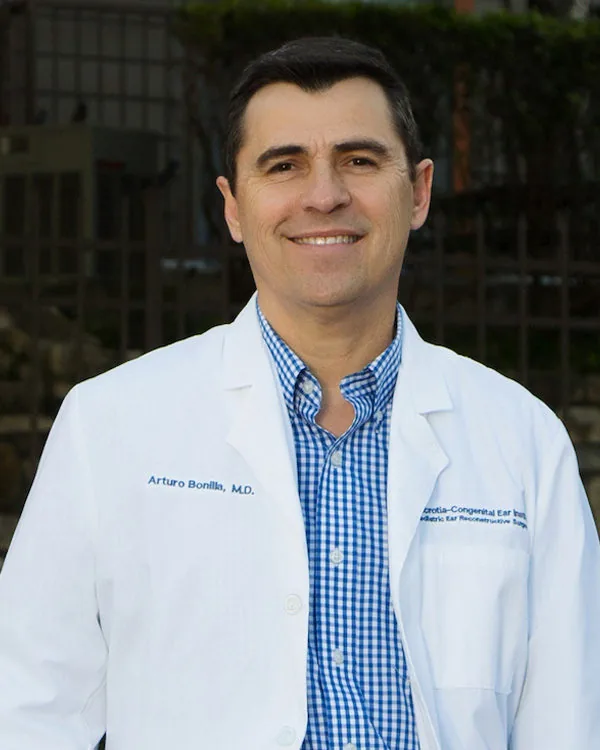
Medically reviewed by Arturo Bonilla, MD — August 2026
What Exactly Is Rib Cartilage — and Why Does It Matter?
Cartilage is a specialized connective tissue found throughout the body — in your joints, nose, trachea, and ribs. Unlike bone, cartilage is flexible. Unlike soft tissue, it holds its shape. It sits in a biological middle ground that makes it uniquely suited to reconstructing structures that need both form and resilience.
Rib cartilage — the cartilage connecting the ribs to the breastbone — is the most abundant harvestable cartilage in the body. It is dense enough to be carved into precise three-dimensional anatomical forms, yet pliable enough to flex safely under normal contact. In a child aged 6 and older, ribs 6, 7, and 8 typically provide enough material to construct an entire ear framework.
Critically: rib cartilage is living tissue. It has cells (chondrocytes), a supporting matrix, and the capacity to integrate with surrounding tissue after transplantation. When placed beneath the skin at the ear site, it is accepted by the body as its own. It is not rejected. It is not tolerated. It is adopted — becoming a permanent, biological part of the child’s anatomy.
No synthetic material does this. Porous polyethylene (Medpor/Su-Por), silicone, and irradiated donor tissue are all inert — their cellular activity ends where the child’s body begins. The boundary between implant and patient is permanent. Autologous cartilage integrates fully as the patient’s own tissue.
Rib Cartilage at a Glance
The material that becomes your child’s new ear — from their own body.
Seven Clinical Advantages of Natural Rib Cartilage
These are not preferences or opinions. They are properties of living tissue that no manufactured material replicates.
How Living Tissue Compares to Synthetic Alternatives
The two most common alternatives to natural rib cartilage are porous polyethylene implants (Medpor/Su-Por) and ear prosthetics. Each has genuine advantages — earlier timing in the case of Medpor/Su-Por, and no surgery at all in the case of an adhesive prosthetic. These advantages are real and worth acknowledging.
But there is a fundamental category difference between what a living autologous cartilage reconstruction is and what a synthetic alternative is. A cartilage ear becomes part of the child. A synthetic alternative remains foreign to the child — managed, tolerated, or worn.
The case for cartilage is not that it is more convenient in the short term. It often requires waiting until age 6, it requires one or two surgical stages depending on grade, and it leaves a small chest scar. The case for cartilage is that it is the only option that produces an ear the child’s own body fully accepts — one that grows with them, feels like them, and requires nothing of them for the rest of their life.
The implant extrusion problem. One of the most significant clinical concerns with Medpor/Su-Por is that the implant can slowly work its way through the overlying skin — a process called extrusion. Published complication rates vary across studies — a reflection of differing follow-up durations and patient populations. Families are encouraged to review the literature and ask their surgeon directly. When extrusion occurs, the implant is often too embedded in ingrown tissue to remove cleanly. The revision options are severely limited. Cartilage reconstruction carries no equivalent risk — it does not extrude because it is not a foreign body pushing against the skin from within. Published evidence: Ma & Lloyd, J Craniofac Surg 2022 (PMID: 34643598) — systematic review reporting 15% extrusion or infection rate with Medpor versus 2% with autologous cartilage. Sharma et al., Laryngoscope 2024 (PMID: 37607106) — national database study confirming higher wound complication rates (8.6% vs. 2.8%, p = 0.037) and longer operative times (350 vs. 235 minutes) with alloplastic implants. View full research summary →
Prosthetic ears serve specific cases well — patients for whom surgery is not possible, those with prior failed reconstruction, or families who prefer a non-surgical path for their child. But the permanent attachment to a removable device — one that must be cleaned nightly, replaced every few years, and cannot sweat or tan alongside the rest of the face — is a fundamentally different relationship with one’s own appearance than having a permanent biological ear.
What happens if the Medpor/Su-Por implant fails?
Long-Term Results — No Maintenance or Replacement Required
After the second and final stage of reconstruction is complete, the cartilage ear requires no maintenance, no follow-up procedures, no monitoring, no replacement. It simply lives as part of the child — growing, aging, and adapting alongside them.
What “permanent” actually means
The Rib Harvest Scar — What Families Should Know
The most frequently cited disadvantage of rib cartilage reconstruction is the chest incision required to harvest the cartilage. This is a real consideration and deserves an honest answer.
Dr. Bonilla’s technique uses a single incision approximately 1¼ inches long, placed low on the lateral chest wall where the ribs are most accessible. The incision is closed in layers and heals into a fine, faded line — typically covered by clothing and nearly imperceptible within a few years.
In more than 30 years of practice, Dr. Bonilla reports that patients rarely express regret about the rib scar. When asked, patients and families describe a clear and consistent sentiment: the scar is a small trade for a permanent, living ear. It is the mark of something built — not purchased, not borrowed, not implanted. For most patients, it carries no negative psychological weight. For some, it carries meaning.
The comparison that matters: a 1¼ inch chest scar that fades to near-invisibility, versus a lifetime of implant surveillance, scalp flap scarring, potential hair loss at the incision site, and the persistent risk that the implant one day needs to be removed.
Why He Has Used Only This Technique for 30 Years
Founder, Microtia & Congenital Ear Institute, San Antonio, TX
What “exclusive” means
Dr. Bonilla does not use Medpor/Su-Por as the ear reconstruction framework. He does not offer cadaver cartilage. He does not rotate between techniques based on which one a family requests. This is a deliberate clinical position — not a limitation of his practice, but a conviction about what produces the best outcome. The reconstructed ear itself is always built entirely from the child’s own natural rib cartilage. Dr. Bonilla does use a small Su-Por wedge — which he designed — placed entirely behind the cartilage framework during Stage 2 elevation to maintain projection permanently. It is not visible, forms no part of the ear structure, and lies fully protected behind the natural cartilage ear.
A surgeon who performs the same technique exclusively at high volume develops a level of refinement that concentrated repetition makes possible. Dr. Bonilla's practice is built on this principle.
His assessment of alternatives
Dr. Bonilla reviews the literature on synthetic implants and stays current with published outcomes data. He acknowledges the genuine advantage of earlier surgical timing that Medpor/Su-Por allows. He does not dismiss families who consider it.
His conclusion after three decades of observation: the long-term complication profile of synthetic implants — extrusion, infection, revision difficulty, growth asymmetry — produces outcomes that, in his clinical judgment, do not serve the patient as well as living cartilage does across a lifetime. That is his honest assessment.
Fifty Years of Evidence for Rib Cartilage Reconstruction
The technique Dr. Bonilla uses has been refined and documented since the 1960s. No other microtia reconstruction approach has comparable long-term data.
Questions Families Ask About Cartilage Reconstruction
Request a Consultation
Dr. Bonilla consults with families worldwide via telehealth. To get started, submit your information through the contact form and his team will reach out to schedule a virtual consultation. He will review your child’s grade, rib cartilage development, and candidacy, and give you a direct, honest assessment of what reconstruction would look like.