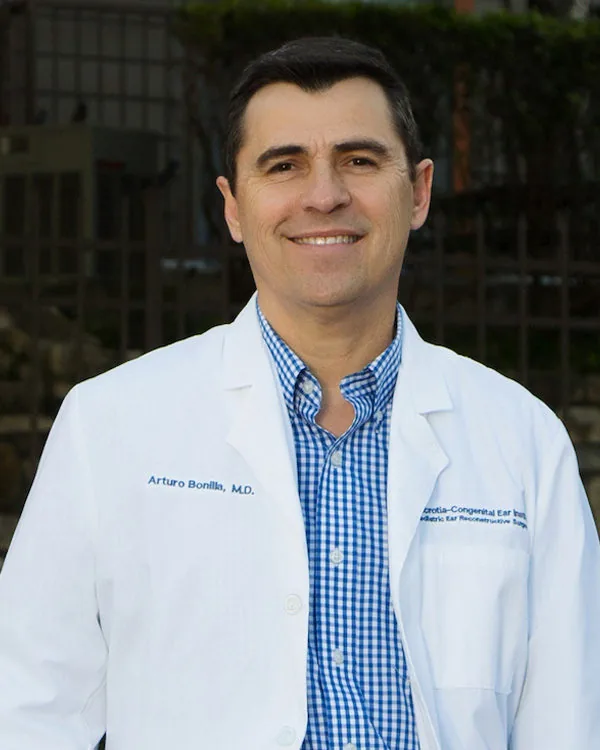
Thirty years ago, I performed my first microtia reconstruction on a seven-year-old boy from south Texas. I remember being struck by how still he was in the preoperative room — not frightened, exactly, but watchful. He had that particular quiet that children develop when they have spent years noticing how others look at them. His mother held his hand and looked at me in a way that I would come to recognize many thousands of times: with hope so carefully rationed it had become almost indistinguishable from worry.
I did not sleep well the night before that first case. I was trained. I had prepared. But training and preparation are different things from knowing, and at that point, I did not yet know this operation the way I know it now — in the way that a surgeon’s hands eventually learn to know a procedure: not as a sequence of steps, but as something closer to a conversation with tissue, with anatomy, with the particular biology of each individual child.
I have thought about that boy many times over the years. I think about him when I meet families who come in with that same careful hope. I think about him when I am asked — and I am asked fairly often — why I chose to focus exclusively on microtia when I could have had a broader surgical practice. The honest answer is that I am not entirely sure I chose it so much as it chose me. But I have never once questioned it.
Here is some of what thirty years has taught me.
The Technical Truth About Ear Reconstruction
Rib cartilage ear reconstruction is one of the most technically demanding procedures in all of reconstructive surgery. I say this not to impress you, but because I think families deserve to understand what they are asking of a surgeon when they walk into a consultation — and what they deserve to expect in return.
The external ear is a three-dimensional sculpture of extraordinary complexity. It is a structure with hills and valleys, shadows and subtle asymmetries that, when they are right, read to the human eye as entirely natural. When they are not quite right, something in the brain registers the difference even if the observer cannot articulate it. Human beings are exquisitely attuned to faces and the features that belong to them. We notice, even when we are not trying to.
Learning to carve rib cartilage into a structure that mimics that complexity took me years. Not months — years. I will not pretend otherwise. In those early years, I was competent. By the time a decade had passed, I was considerably better. Now, three decades in, I find myself doing things with the cartilage framework that I could not have done twenty years ago — refinements of detail, approaches to the helical rim and the antihelix that only become possible once the hands have had enough repetition to move with something approaching certainty.
There is no shortcut to that kind of experience. Volume matters significantly in microtia surgery. The technical refinement that comes from exclusive, high-volume practice in a single procedure develops over many years of concentrated repetition — something families deserve to understand when evaluating surgical experience.
The external ear is a sculpture with hills, valleys, shadows, and subtle asymmetries that — when they are right — the human eye reads as entirely natural. Learning to carve rib cartilage into that level of anatomical complexity is a process that took years, not months.
Over thirty years, I have also watched the field evolve. I have been part of conversations about synthetic frameworks versus rib cartilage, about staged approaches versus single-stage, about the role of newer imaging technology in surgical planning. I have changed my mind about some things. I have had techniques I was proud of become superseded by better ones. That process — of being willing to be improved — is, I think, as important as any individual technical skill. Certainty can be dangerous in medicine. I try to hold my approaches firmly enough to execute them well and loosely enough to abandon them when something better comes along.
What Families Always Ask
In thirty years, the questions families ask in consultations have remained remarkably consistent. The most common one, delivered in some version almost every time, is: “Will it look real?”
I understand why that question comes first. But I have learned that it is rarely the deepest question. The real question — the one underneath — is usually something more like: “Will my child be okay? Will other children notice? Will this take away the thing that makes him different in a way that causes him pain?”
I try to answer both questions, because I think both deserve answers.
To the first: yes, in the hands of a surgeon with sufficient experience, rib cartilage reconstruction can produce an ear that is remarkably natural in appearance — one that a stranger, standing a few feet away, would not identify as reconstructed. That is not a guarantee of perfection. Ears, natural and reconstructed alike, are imperfect structures. But naturalness — the quality of reading as an ear, of not announcing itself — is the consistent goal, and in experienced hands it is reliably achievable.
To the second: I tell families that the surgery changes something real, but that it is not the whole answer. Children who have been treated unkindly because of a visible difference do not simply forget that experience once the bandages come off. The reconstruction gives them something they did not have before — a choice about how visible their difference is, a greater freedom in how they move through the world. But they still need the adults around them to take seriously what they have been through, and they still need time.
Questions Families Sometimes Hesitate to Ask
These are harder to write about, but I think they are important.
Many parents come in carrying guilt that they have never said out loud. They wonder if they did something during pregnancy that caused the microtia. They wonder if there was a genetic signal they missed, a supplement they should have taken, a moment of exposure to something that mattered. This guilt is almost entirely unfounded — the overwhelming majority of microtia cases have no identifiable cause, and what research suggests involves a complex interplay of factors far outside any parent’s control. But knowing that intellectually does not always release someone from feeling it emotionally.
I try to make space for those questions. Not because I have perfect answers — I don’t — but because carrying an unasked question for years is its own kind of burden, and the consultation room is one of the few places where it is appropriate to put it down.
Parents also sometimes fear asking whether their child actually wants the surgery. There is a complicated parental instinct at work here: the desire to do something about the thing that causes their child pain, alongside the fear of projecting that desire onto a child who may be navigating their difference with more equanimity than their parent. My strong view — developed over many years and many conversations with patients both before and long after surgery — is that when it is possible, children should be old enough to have genuine input into this decision.
That means I generally prefer to operate when children are older than five or six, when the rib cartilage has grown sufficiently to harvest and when the child can understand, at an age-appropriate level, what is happening to them and why. Waiting requires patience from families who are understandably eager. But a child who has participated in this decision — who comes in having thought about it, having asked their own questions, having in some sense claimed the outcome as something they wanted — recovers differently than one who simply experienced something done to them while they were too young to understand.
That difference matters.
When the Bandages Come Off
I have been present for thousands of first reveals — the moment, after the bandages come off, when a child or teenager looks in a mirror for the first time. I do not think I will ever fully get used to it, and I am not sure I want to.
It is not always what you might imagine. Sometimes there is immediate, uncomplicated joy — a child who breaks into a wide grin and then reaches up to touch the new ear very gently, as though verifying that it is real. Sometimes there are tears, from the child or the parent or both. Sometimes there is a long, quiet, serious look — an older child or teenager studying themselves with an expression that is impossible to read from the outside.
What I have noticed, across all those different reactions, is that the moment is nearly always private in some essential way — even when the room is full of family members. Something is happening between the child and their own reflection that is not quite accessible to anyone else. I have learned, over the years, to try to stay out of it.
Something is happening between that child and their own reflection that is not quite accessible to anyone else in the room. I have learned, over the years, to try to stay out of it.
I had a patient years ago — a twelve-year-old girl who had been through a difficult year socially and who came into the surgery with an almost deliberate matter-of-factness about the whole thing. She was not going to let any of us see her be vulnerable about it. After her bandages came off, she looked in the mirror for a long time without saying anything. Then she said, very quietly, to no one in particular: “It looks like mine.”
Not “it looks like an ear.” Not “it looks good.” It looks like mine.
That is still, I think, the most accurate description of what a successful reconstruction accomplishes that I have ever heard. Not that we have given a child an ear. But that we have given them one that belongs to them.
What I Am Still Learning
People sometimes ask me, after thirty years, whether there is anything left to learn in this work. The honest answer is that I feel as though I understand the surgery more deeply every year — and that the deeper I understand it, the more I notice the distance between where I am and where it is still possible to go.
I am still refining my approach to the helical rim — the outer rim of the ear, which is one of the most visible and technically demanding aspects of the reconstruction. I am still learning things about the way cartilage behaves over time, about the subtle long-term changes that affect final outcomes in ways you can only see if you follow patients for decades. I am still thinking about which patients are ideal candidates for which surgical approaches, and I suspect I will be thinking about that for the rest of my career.
I am also still learning from my patients in ways that have nothing to do with technique. A teenager I operated on a few years ago sent me a message to tell me she had started volunteering with a support group for families of children with microtia — that her own experience had made her want to help other families feel less alone in the early days after diagnosis. A young man I operated on when he was a child is now studying medicine himself. I do not tell these stories to take credit for anything. These people would have become who they are regardless of what I contributed. But there is something that happens when you follow a practice long enough — you get to see the long arc of what people do with their lives, and it is humbling in a way that is genuinely difficult to describe.
Why I Have Never Considered Doing Anything Else
Microtia is a rare condition. The population of children who are born with it each year is small, and many of them will never make their way to a specialist. The families who do find their way here — to this office, to this practice — have often traveled a long road to get to the consultation table. Many have been told conflicting things by different doctors. Many have spent years researching, worrying, hoping, and wondering. Many have done all of that while trying their best to help their child feel normal and loved and whole, without knowing what the future looked like.
By the time they sit down across from me, what they need most is an honest assessment — of what their child’s anatomy presents, what surgery can realistically accomplish, and what the recovery will involve. I come from a family of physicians, and what was spoken of most was never self-promotion — it was the work itself, and whether the work could withstand the honest scrutiny of time. The technique either holds up over decades of outcomes, or it doesn’t. In the case of rib cartilage reconstruction, the record is not ambiguous: it remains the standard by which all other approaches are measured, practiced by the large majority of microtia surgeons worldwide because the long-term outcomes data supports living autologous tissue as the most durable and biologically compatible material available, and because I think families navigating a loud and sometimes persuasive information landscape deserve to know that the weight of published long-term outcomes continues to support rib cartilage as the standard against which other approaches are measured.
What they need is someone who has done this long enough to be honest with them — about what surgery can do and what it cannot, about what their specific child’s anatomy presents and what that means for the outcome, about the realistic arc of recovery and the things that are genuinely uncertain.
That kind of honesty is something I can only offer because of time. Thirty years of operating, of following patients through their recoveries and into their adult lives, of making mistakes and understanding why, of refining and being refined — all of that accumulation is in service of being able to sit across from a family and tell them something true. Not something reassuring. Something true.
That is why I have never considered doing anything else. Not because microtia surgery is glamorous — it isn’t — or because it gets easier over time — it doesn’t, not really — or because the cases are simple. It is none of those things. But there is a particular kind of meaning that accumulates in work done long enough, with enough care, in service of something that genuinely matters to the people you are serving. I found that meaning here, in this unusual and specific corner of reconstructive surgery, thirty years ago. And every year since, it has only deepened.
I still think about that seven-year-old boy from my first case. I hope he is well. I hope that what we did for him gave him something useful — not just an ear, but a little more freedom to move through the world on his own terms. That, in the end, is all any of us can really hope to give.