Hearing Development Timeline
What conductive hearing loss means at every developmental stage — from the first weeks of life through adolescence — and exactly what can be done about it at each age.
An Important Clinical Distinction
There are two types of hearing loss. Which type your child has determines the entire outlook — and for microtia children, the news is consistently better than parents initially fear.
✓ Conductive Hearing Loss (what microtia causes)
The inner ear — the cochlea and hearing nerve — is intact and working normally. Sound simply cannot reach it because the ear canal didn't form. This is like having a working radio but no antenna. The signal exists; it just isn't getting through. Conductive hearing loss is addressable with hearing devices and potentially with canal reconstruction.
✗ Sensorineural Hearing Loss (not typical in microtia)
The hearing nerve or cochlea itself is damaged or absent. This type of hearing loss is permanent and not correctable. It is not what microtia causes. When parents Google hearing loss, they often find information about sensorineural loss — which may not apply to their child. Confirming this distinction with an ABR hearing test is one of the most reassuring steps in the early weeks.
The BAHA Softband — Early Bone Conduction Hearing Support
A bone-anchored hearing aid (BAHA) on a soft elastic headband bypasses the absent ear canal entirely by conducting sound through the skull bone directly to the inner ear. It can be fitted as early as one month old, requires no surgery, and restores a significant portion of hearing during every critical developmental window. For bilateral microtia, it is an urgent early priority. For unilateral microtia, it reduces the everyday listening challenges that accumulate across all the stages below. Nearly all of the urgency that appears in the timeline can be directly addressed by fitting the BAHA softband promptly and consistently.
The central auditory cortex — the part of the brain that processes and interprets sound — is laying down its foundational neural architecture in the first weeks of life. Sound stimulation during this window directly shapes the physical structure of auditory processing pathways. This is not figurative — neural pathway formation and synaptic growth in the auditory cortex are at their most rapid in the first six months, and the connections established now directly shape auditory processing capacity for life.
The auditory input that drives cortical development is reduced or absent on the affected side. For bilateral microtia, this affects both channels. The brain can compensate to a significant degree, but prompt intervention reduces the degree of compensation required and supports more typical auditory pathway development.
The normal ear is providing full sound stimulation on one side. Binaural processing — the brain's ability to use two ears for spatial hearing and noise filtering — is reduced, but single-channel auditory development proceeds normally. Priority: confirm inner ear integrity on the affected side with ABR testing.
- ABR (Auditory Brainstem Response) test: Confirms inner ear function. Performed while the newborn sleeps. Can be done within the first weeks. This is the most reassuring test a family can do.
- Pediatric audiology referral: Get on the schedule immediately. Do not wait for a surgical consultation to initiate hearing evaluation.
- BAHA softband: Can be fitted as early as 4–6 weeks. A soft elastic headband with a bone conduction processor. No surgery. Immediately addresses the hearing gap.
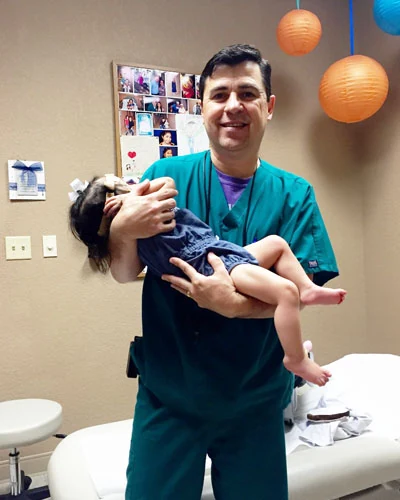
Dr. Bonilla's practice welcomes consultations from newborns. The first visit establishes the hearing plan, confirms the diagnosis grade, and provides the family with a complete roadmap from birth through reconstruction. A referral to a trusted pediatric audiologist for ABR testing and BAHA fitting is initiated immediately. There is no surgical intervention at this age — the focus is entirely on hearing support and family guidance.
The auditory cortex is undergoing its most rapid structural development. Neural connections that are stimulated are reinforced; those that aren't are pruned. The brain is simultaneously learning to localize sound (determine where sounds are coming from), distinguish phonemes (the building blocks of language), and differentiate meaningful sound from background noise. Parent voice recognition deepens significantly during this window.
Spatial hearing and sound localization are the primary impacts on the affected side. The brain cannot triangulate sound location with only one clear channel. Phoneme discrimination — distinguishing speech sounds — is reduced on the affected side. With a BAHA softband in consistent use, the majority of this stimulation gap is addressed.
Your baby startles to sound, turns toward voices, and is developing speech perception normally through the intact ear. The primary concern is localization — the ability to determine where sounds are coming from. Consistent BAHA use improves this. Talk to your baby from both sides. Face them directly when speaking. This matters more than parents often realize.
- BAHA softband: Should be in consistent daily use. Work with audiologist on optimal fit as baby grows — the band needs regular adjustment.
- Positioning: Position the baby's better-hearing ear toward the primary sound source (your voice, TV, music) during awake time.
- Early Intervention program: In the US, children under 3 with hearing loss qualify for free Early Intervention services. Contact your state program now.
- Audiologist follow-up: Schedule every 3 months to adjust device settings as the child grows and to monitor auditory development.
No surgical intervention at this age — this is the hearing support and monitoring phase. Dr. Bonilla's team provides guidance on BAHA use, Early Intervention enrollment, and audiologist coordination. Families receive a written developmental roadmap. The next significant medical milestone in Dr. Bonilla's surgical planning is the assessment of rib cartilage development that begins years from now.
The child begins canonical babbling — stringing consonant-vowel combinations (ba-ba, ma-ma, da-da). The phonemes the child hears in their environment are being catalogued and stored as the raw material for future speech production. By 9–10 months, a typically developing child has narrowed their phoneme perception to the sounds of their native language. Joint attention — looking at the same thing an adult is looking at — emerges and is closely tied to auditory input.
The phoneme inventory built during this window is directly limited by what the child can hear. Sounds that aren't perceived clearly may not enter the inventory and may require speech therapy later to acquire. For unilateral cases with BAHA support, impact is typically modest. For untreated bilateral cases, this window represents a meaningful risk to the phoneme foundation for later speech.
Babbling onset should be on track (6–8 months). If babbling is absent or significantly delayed, notify your pediatrician and audiologist immediately. With BAHA support, unilateral microtia children typically develop phoneme inventories comparable to their peers. Note that high-frequency sounds (s, sh, f) are harder to perceive with one ear and may need extra attention.
- BAHA softband: Every waking hour. Critical for phoneme input quality.
- Speech-language pathology (SLP): Begin if not already started. For bilateral cases this is urgent; for unilateral, begin if any developmental concerns arise.
- Auditory verbal therapy (AVT): A specialized approach for children with hearing loss that focuses on teaching the child to use their residual hearing maximally. Ask your audiologist about AVT providers.
- Consistent narration: Parents talking continuously about what they see and do is one of the highest-impact interventions available. Narrate everything.
Still well before the surgical planning window, but Dr. Bonilla's team actively coordinates with the family's audiologist and SLP at this stage to ensure hearing support is optimized. Families in this window receive guidance on school preparation that begins years from now. A hearing management plan is updated at each annual visit.
A typically developing child goes from approximately 5–10 words at 12 months to 200–300 words at 24 months. Two-word combinations appear around 18–20 months. Receptive vocabulary (words understood) grows even faster than expressive vocabulary. Symbolic understanding deepens — the child learns that words stand for things. Listening in background noise becomes an emerging skill.
Vocabulary acquisition depends directly on the number of words clearly heard. Research on children with conductive hearing loss from other causes (e.g., chronic otitis media) consistently shows that reduced hearing input during this window correlates with smaller vocabulary size and later reading difficulties. With BAHA support, these risks are substantially reduced. Without it, they are real.
Vocabulary development is typically on track or only mildly delayed with adequate BAHA use. Watch the 18-month milestone closely: 50+ words and emerging word combinations. In noisy environments — daycare, family gatherings — position yourself on the child's better-hearing side and reduce background noise when possible (turn off TV during conversation).
- Early Intervention (under 3): If enrolled, this is the most intensive period. Maximize the hours of direct SLP service — the federal mandate allows you to advocate for more if your child needs it.
- BAHA softband: Every waking hour, especially during any language-rich activity (reading, conversation, play).
- Aided audiogram: Your audiologist should be verifying that the BAHA is providing adequate amplification across the speech frequency range.
- Book reading: Reading aloud is the single highest-density vocabulary intervention available to parents. 20–30 minutes daily has documented developmental impact.
Annual consultation visits are encouraged to maintain the care relationship and update the hearing plan. Dr. Bonilla's team monitors reported language milestones and coordinates with the family's Early Intervention team. Parents receive updated guidance on the surgical planning timeline — they can see the road ahead clearly, even though surgery is still years away.
Grammatical structure emerges — the child begins adding verb endings, plurals, and pronouns. Multi-word sentences grow from 2-word to 3–4 word utterances. Social language develops rapidly: turn-taking in conversation, asking questions, using language to direct others. Phonological awareness — the ability to manipulate sounds in words — begins at the end of this period and is foundational for later literacy.
Grammatical morphemes — the small function words and word endings that carry grammatical meaning — are among the hardest to hear at reduced volume. Children with conductive hearing loss often omit these in their speech not because of a language disorder but because they haven't heard them clearly enough to internalize them. This is a direct, addressable effect of hearing loss — not a language disorder.
Grammar development is typically on track. The key transition this year: Early Intervention ends at age 3, and school district services begin under an IEP. Initiate the IEP evaluation at 2.5 years — do not wait until the child turns 3. The IEP can secure classroom accommodations (FM system, preferential seating) before preschool begins.
- Early Intervention → IEP: At age 3, services transition from Part C (Early Intervention) to Part B (school district IEP). This requires a new evaluation. Begin the process at 2.5 years.
- Classroom FM system: An FM or Roger system transmits the teacher's voice directly to the child's hearing device. This is one of the most impactful classroom tools — request it in the IEP.
- BAHA processor upgrade: Newer BAHA processors have better noise reduction and connectivity. Discuss with your audiologist whether an upgrade is appropriate.
Annual visits continue. Dr. Bonilla's team provides families with a letter summarizing the diagnosis, the hearing plan, and the anticipated surgical timeline — useful documentation for the IEP process and for school communication. At this age, a more specific surgical planning conversation begins: the team starts tracking rib cartilage development in preparation for future reconstruction.
Phonological awareness — the ability to consciously manipulate the sound structure of language (rhyming, syllable counting, identifying first sounds in words) — is the strongest predictor of reading success and develops rapidly between ages 3–5. Narrative language emerges: the child can tell a story with a beginning, middle, and end. Complex sentence structures become established. Listening to and understanding extended discourse (stories, instructions) becomes a daily academic skill.
Phonological awareness depends on the clarity of phoneme perception. Children who cannot reliably hear the difference between similar sounds (s vs. sh, b vs. p) may have difficulty with phonological tasks even when overall language development is on track. This is the pre-reading window where hearing quality has its most direct academic impact. FM system use in the classroom becomes especially valuable here.
Phonological awareness development is typically on track with BAHA support. The classroom environment is the main concern — preschool classrooms are acoustically challenging. Advocate for preferential seating (front-center, better-hearing ear toward the teacher) and an FM system if the teacher uses one. Teacher awareness is important: provide the teacher note from the What to Tell Your Family guide.
- FM / Roger system: The teacher wears a small microphone that transmits their voice directly to the child's BAHA processor. This has the largest single impact on classroom hearing access.
- Preferential seating: Front and center, better-hearing ear toward teacher and the primary instruction area.
- Phonological awareness intervention: If phonological awareness testing shows delays, explicit intervention is highly effective at this age.
- Classroom acoustics awareness: Hard floors, high ceilings, and background noise are barriers. Request classroom accommodations for acoustic management if possible.
Surgical planning becomes more specific at ages 4–5. Dr. Bonilla assesses rib development and begins establishing the surgical timeline. Families receive a concrete roadmap: when rib cartilage will be assessed for readiness, the anticipated age range for Stage 1 surgery, and whether one or two stages are needed and what each stage will involve. The hearing plan is updated to bridge from current BAHA use through the surgical reconstruction years.
In Dr. Bonilla’s practice, the usual recommendation for reconstruction is 6 to 9 years of age, depending on the patient’s height and the size of the opposite ear. This is not a limited window for surgery; patients older than 9 years have not missed the opportunity for reconstruction.
BAHA softband use continues through the surgical stages. The reconstruction addresses the outer ear appearance; canal reconstruction (atresiaplasty) is a separate procedure that may be performed after outer ear reconstruction if the CT scan anatomy is favorable. Not every child is a candidate for atresiaplasty — the temporal bone anatomy determines this. For children who are candidates, the combination of outer ear reconstruction followed by atresiaplasty represents the most complete restoration.
Stage 1 surgery is scheduled based on rib cartilage readiness. The child participates in the decision at this age — their own readiness and desire matter. Dr. Bonilla engages directly with the child, not just the parents. School absence planning: Stage 1 typically requires 1–2 weeks of recovery; Stage 2, when needed (approximately 2 months later) is shorter. Plan around the academic calendar.
- Stage 1: Rib cartilage is harvested and hand-carved into a complete ear framework, which is placed under the skin on the side of the head. In the same surgery, the earlobe is rotated into position, the tragus is formed, and the concha is deepened — the complete ear structure in a single stage. Overnight hospital stay. Drains are removed at a follow-up visit 5–7 days after surgery. Return to school: 5 to 7 days.
- Stage 2, when needed (approximately 2 months later): The ear is elevated off the head, creating natural three-dimensional projection. Fully outpatient — same-day discharge. A small sponge behind the ear is removed at a follow-up visit 5–7 days later.
- Atresiaplasty (if eligible, after Stage 2 elevation): The ear canal is surgically opened to improve hearing. Dr. Bonilla refers appropriate candidates to neurotology specialists and coordinates the timing with ear reconstruction.
This is the heart of Dr. Bonilla's surgical practice. The rib cartilage framework is carved by hand over several hours — each structure of the ear (helix, antihelix, tragus, concha) sculpted individually and assembled into a precise three-dimensional construct. The framework is a mirror image of the normal ear, matched to the individual child's anatomy. The goal is an ear that looks natural from every angle, grows with the child, and never needs to be replaced. For patients who are not atresiaplasty candidates or who elect not to pursue canal reconstruction, Dr. Bonilla performs bone-anchored hearing implant surgery concurrently with ear reconstruction — eliminating the need for a separate surgical procedure and additional anesthesia. Patients who are eligible candidates for atresiaplasty are referred to neurotologist specialists, with sequencing coordinated carefully around the reconstruction timeline.
Social self-concept and peer comparison become central. Children at this age are acutely aware of how they appear to peers and are developing a sense of personal identity. Physical appearance becomes intertwined with social standing in ways it wasn't in earlier childhood. For children who have completed reconstruction, this is often the age when they begin to feel the social relief of having a natural-looking ear — peers no longer comment on it.
For children who have had reconstruction and atresiaplasty, natural hearing through the reconstructed canal is becoming established. The brain adapts to using the new hearing channel — this takes weeks to months and is supported by audiological follow-up. For children who are not candidates for atresiaplasty, BAHA continues and may transition from the softband to a surgically implanted abutment at this age (a minor procedure).
Most children in this range who had reconstruction at the usual recommended age have completed two-stage reconstruction and are in monitoring. The ear looks natural. Hearing continues via BAHA or atresiaplasty. Academic accommodations (FM system, preferential seating) should remain in place through middle school regardless of surgical status.
- Atresiaplasty follow-up: If canal reconstruction was performed, audiological monitoring of hearing levels through the new canal every 3–6 months for the first 1–2 years.
- BAHA osseointegrated abutment: For children not pursuing atresiaplasty, a surgically implanted titanium abutment (minor procedure) replaces the softband with a more secure attachment. Typically performed at age 10–12.
- IEP review: Update accommodations to reflect current hearing status and any change in surgical status. Middle school transition planning should begin at this age.
- Psychosocial check-in: If the child shows signs of social difficulty related to their ear, a consultation with a psychologist familiar with children with visible differences is valuable.
Post-reconstruction monitoring visits confirm that the cartilage framework is integrating well and the ear is maintaining its appearance. Dr. Bonilla personally evaluates each patient's reconstruction results at these visits. Any minor refinements — small cartilage adjustments, scar revisions — can be addressed at this stage if desired. For patients who completed atresiaplasty, hearing outcomes are reviewed and adjusted. Dr. Bonilla remains available to families for as long as needed.
For patients who had rib cartilage reconstruction at the usual recommended age, this stage confirms the long-term success of the approach: the reconstructed ear grows proportionally with the face and head through adolescence — something only possible with living autologous tissue. This is one of the most clinically significant advantages of natural cartilage reconstruction over synthetic alternatives. Identity consolidation in adolescence is healthier when the ear looks natural and no longer draws attention.
Hearing status at this stage reflects the cumulative management across the timeline. Adolescents with successfully completed atresiaplasty are using natural hearing through the reconstructed canal — often with aided thresholds in the normal or near-normal range. Those without atresiaplasty are using BAHA — either osseointegrated or softband — with outcomes that support full academic and social participation. Any residual hearing difficulties that affect academic performance should be addressed in the high school IEP transition plan.
Unilateral hearing loss is a permanent feature of the auditory landscape for children who did not have atresiaplasty. The brain has adapted to single-sided hearing by this point. Hearing device use becomes a personal decision for the adolescent — their autonomy in managing their own care should be respected. High school and college accommodation plans should be established proactively.
- Late reconstruction in older children and adolescents is possible: Dr. Bonilla regularly performs reconstruction on teenagers. The technical approach adapts to the patient's anatomy and age. Results are very good — the primary difference from the usual recommended age is that rib cartilage is more developed, requiring careful assessment. Dr. Bonilla is an exclusively pediatric surgeon, treating patients from birth through age 17.
- The patient's own readiness matters most: An adolescent who is ready and motivated for surgery will have a better experience and outcome than one being pressured. Dr. Bonilla engages directly with the teenager as the primary decision-maker.
- No permanent window closure: There is no age at which reconstruction becomes impossible. If an adolescent is considering it, a consultation is always appropriate.
Long-term follow-up visits confirm the stability of the reconstruction as the face matures. Dr. Bonilla treats the adolescent as the primary patient — not the parents. Any desire for refinements is discussed directly with the patient. For adolescents who are only now considering reconstruction, Dr. Bonilla provides a direct, honest assessment of what is achievable at their current age and anatomy, and what the process will involve. The consultation is never pressured — it is educational and empowering.
How Dr. Bonilla Thinks About the Whole Timeline
Every decision across these 18 years is guided by three principles that are easy to say and hard to consistently practice.
Hearing first, appearance second
The hearing plan comes before the surgical plan, not after. A child who enters the language explosion window without adequate hearing support can face challenges that persist for years. Dr. Bonilla treats the BAHA fitting as the first medical priority — even before reconstruction is on the table — because hearing access during the critical developmental windows is not recoverable.
Optimal windows exist — and so does recovery
There are windows in development where intervention has maximum impact. But there are no permanent closures. Children who enter care late — diagnosed at age 4, or who didn't have BAHA support until age 3 — can and do achieve excellent outcomes with intensive, well-coordinated support. The timeline above shows the ideal; the reality is that Dr. Bonilla has seen children start late and finish well. Families who begin care later than ideal can still achieve excellent outcomes with well-coordinated support. There is no wrong time to start.
Living tissue grows — that's the whole point
The reason Dr. Bonilla uses natural rib cartilage exclusively is that it integrates as living tissue and grows with the child. The ear reconstructed at age 7–9 is the same ear — larger, naturally — at age 18. It is not a device, not an implant, not a prosthetic. The entire hearing development timeline points toward a permanent, natural result — one that long-term outcomes data consistently supports.
Where is Your Child on This Timeline?
A consultation with Dr. Bonilla establishes where your child is on this timeline, what the priorities are right now, and what the path forward looks like from your specific starting point.