Your child was just
diagnosed with microtia.
Breathe. Read this first.
This page was written specifically for parents who found out today — maybe hours ago. It's built around one simple idea: some things you need to know tonight, and some things can wait. We'll tell you which is which.
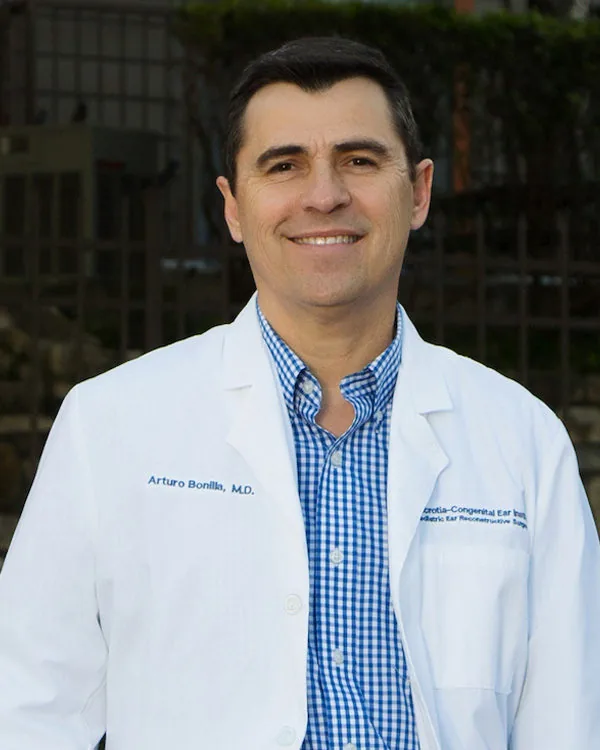
Medically reviewed by Arturo Bonilla, MD — August 2026
Five Things to Know Tonight
You don't need to understand everything tonight. You need five truths — ones that are actually true, and that will let you sleep and function tomorrow.
Microtia occurs in roughly 1 in 6,000–12,000 births. Parents often ask whether they caused their child’s microtia. In nearly all cases, they did not. The cause is usually unknown, although certain genetic conditions, maternal health factors, and prenatal medication exposures can increase risk.
Microtia affects the outer ear — the part you can see. The inner ear, which contains the cochlea and the hearing nerve, develops from entirely different tissue. In the vast majority of microtia cases, the inner ear is intact and fully functional. The hearing loss associated with microtia is conductive — caused by the absent ear canal — not sensorineural (nerve damage). Conductive hearing loss is addressable immediately and surgically correctable over time. This is genuinely important: it means your child's hearing situation is very likely fixable.
In Dr. Bonilla’s practice, the usual recommendation for reconstruction is 6 to 9 years of age, depending on the patient’s height and the size of the opposite ear. This is not a limited window for surgery; patients older than 9 years have not missed the opportunity for reconstruction. You have years. There is absolutely no reason to make any surgery decision tonight. However, if hearing loss is present — which is common — the hearing plan should begin in the first weeks of life. A bone-anchored hearing device (BAHA) worn on a soft elastic headband can be fitted as early as one month old. It requires no surgery and makes an enormous difference in early language and speech development. That is the one thing that genuinely shouldn't wait.
Hearing plan: start earlyDr. Bonilla's technique uses rib cartilage from your child's own body to sculpt a complete, detailed ear. It is living tissue. It grows with your child for life. It looks and feels like a natural ear because it is built from natural material. There is no implant to replace, no rejection risk, no plastic. The technology is mature — it has been refined over decades and performed on thousands of children. The outcome is real.
It is not considered aesthetic surgery. Benefits and out-of-pocket costs vary, so Dr. Bonilla’s office assists families with authorization and insurance clarifications.
A Note on Online and Social Media Research
The internet contains a great deal of information about microtia — and some of it will frighten you in ways that are not accurate or useful. Here is a guide to navigating it.
Three Actions for the Next Seven Days
This is the entire to-do list for this week. Three things. Everything else can wait.
An Auditory Brainstem Response (ABR) test is the gold standard for evaluating hearing in infants. It is completely non-invasive and can be performed while your baby sleeps. It confirms whether hearing loss is present and whether the inner ear is intact — both critical for planning. Ask your pediatrician specifically for a referral to a pediatric audiologist for an ABR test. Don't wait for a routine checkup — request it this week.
Most important step this weekMany parents wait to seek a consultation, thinking it isn't relevant until the child is older. But an early conversation — even years before surgery — gives you a roadmap and replaces uncertainty with a clear plan. An early consultation does three things: Dr. Bonilla confirms the grade, assesses the anatomy, and creates a personalized plan for your specific child — for hearing support now and surgery later. You leave the consultation with a roadmap, and that roadmap removes more fear than anything else you can do. Call (210) 477-3277 or request a consultation online.
Recommended this weekYou don't need to explain microtia to extended family tonight. But you do need at least one person who knows what you're carrying. Choose carefully — someone who responds to hard news with steadiness, not panic-Googling. A simple script for anyone who asks: "Our baby has a condition called microtia — one ear didn't fully develop. It's very treatable. We're already in contact with a specialist and have a plan. We'll share more when we know more." That is enough for now. When you're ready to explain it more fully, we have a guide for exactly that.
For your supportBefore you spend tonight worrying about what your child will never experience — watch this.
This little girl has microtia. She has never heard clearly on the affected side. Watch what happens the moment a bone conduction device is placed behind her ear for the first time.
That reaction — the smile, the clapping — is not unusual. It is what happens when a child with a perfectly normal inner ear finally receives the signal it has been waiting for.
Your child has that same inner ear. This is what is possible — and it is available from birth.
She smiles. She claps. She has never heard like this before.
What to Expect Over the Coming Years
Not as a checklist — but as reassurance that there is a clear, well-established path. Thousands of families have walked it before you.
3 mo
If hearing loss is present, a BAHA softband hearing device can be fitted within the first month of life. It sits on a soft elastic headband — no surgery, no ear molds, nothing invasive. It conducts sound through the skull directly to the intact inner ear. Many parents describe the first time their child turns toward a voice they hadn't heard before as the moment the fear started to lift.
yrs
During these years, your child is growing and thriving. Dr. Bonilla monitors cartilage growth through periodic check-ins. Hearing is supported continuously by the BAHA device. Children with microtia at this age typically carry no awareness that their situation is unusual — they simply haven't been given a reason to think so. The parents tend to carry more of the emotional weight during these years than the children do.
yrs
By age 6–9, rib cartilage is sufficiently developed to harvest enough for a complete ear framework. By age 8–9, the normal ear has reached near-adult size, allowing Dr. Bonilla to match symmetry precisely. Grade II is completed in one stage; other grades are completed in two stages over approximately two months. Most describe the entire process as far less daunting than they feared during those early nights.
The usual reconstruction ageyrs
The reconstructed ear is permanent. It grows with your child, requires no maintenance or replacement, and looks like a natural ear because it is one. Older children and teenagers who underwent surgery earlier consistently report that the ear has simply become part of who they are — something they no longer think about. That is the actual goal: not just a beautiful ear, but a child who has moved on.
Putting Common Online Information in Context
Some facts about microtia sound alarming out of context. Here is what they actually mean.
True — but this hearing loss is conductive (caused by a missing canal), not sensorineural (nerve damage). The inner ear almost always works perfectly. Conductive hearing loss is addressable immediately with the BAHA device and surgically correctable over time.
True for Grade II, which is completed in a single surgery. Grade III, Grade IV, and other grades are completed in two stages over approximately two months. Stage 1 creates the complete ear structure, and Stage 2 elevates the ear.
Rare in the general population — but Dr. Bonilla has treated thousands of children with microtia. For his team, this is not unfamiliar territory. It is the only thing they do. You are not in rare, uncharted waters. Dr. Bonilla has performed this surgery exclusively for over thirty years.
Dr. Bonilla has practiced microtia reconstruction exclusively since 1996, performing no other surgical procedure.
True of the underlying biological cause — but the treatment is extraordinarily well-studied. Thirty years of surgical outcomes data, peer-reviewed published research, and thousands of documented patient results exist for rib cartilage reconstruction. The cause may be imperfectly understood. The treatment is not. You are in good hands.
From Dr. Bonilla
A note from Dr. Bonilla:
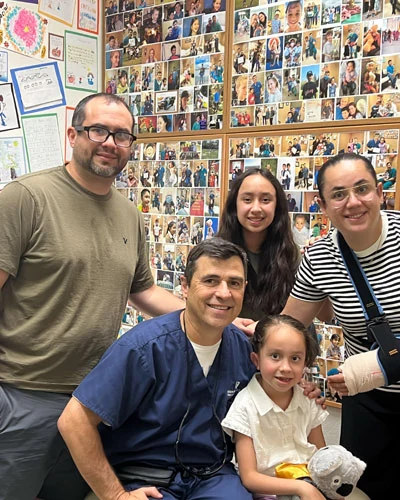
I have been sitting across from parents in your exact situation for thirty years. The fear you are feeling tonight is real — and it will not last. What I have seen, again and again, is that families who understand what microtia actually is — and what is genuinely possible — move from that fear to something much steadier. Not certainty. Not the absence of worry. But a clear sense of what comes next and confidence that their child is going to be okay.
That is what I hope this page has given you tonight.
Contact Dr. Bonilla
Whatever questions you have — tonight or in the weeks ahead — Dr. Bonilla’s team is available to help. Dr. Bonilla’s team is available to answer questions specific to your child — by contact form or phone, whenever you’re ready.
To request a consultation, submit your information through our contact form and Dr. Bonilla’s team will be in touch to schedule a virtual appointment.