Before & After Gallery
These are real results from Dr. Bonilla’s patients — children who came to his practice with microtia and underwent ear reconstruction using their own natural rib cartilage.
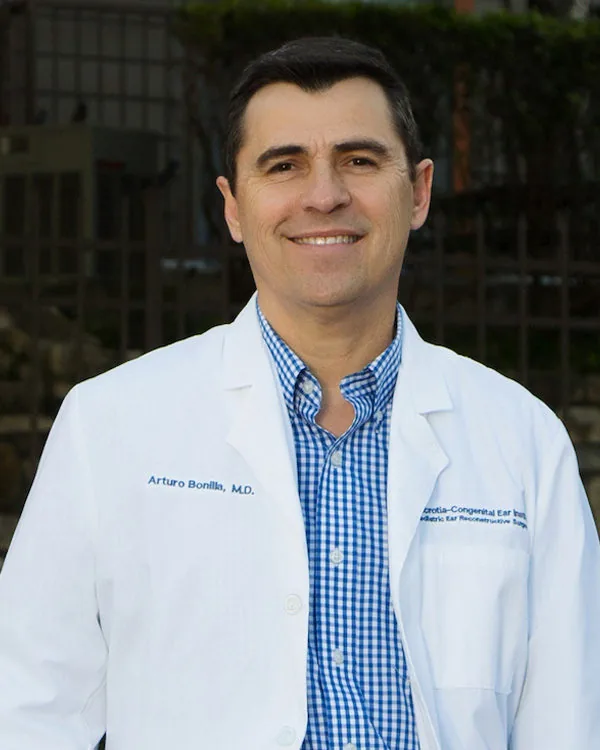
Medically reviewed by Arturo Bonilla, MD — August 2026
Understanding These Results
Cartilage reconstruction produces a softer, more natural ear contour compared to synthetic implants, which tend to have sharper, more rigid definition. Because it uses the patient's own tissue, it also avoids long-term risks such as fracture or implant exposure.
Each surgical approach has specific indications, and treatment decisions are individualized based on the patient's anatomy and goals.
No patients match this filter combination
Try broadening your filters to see more results.
Every ear shown in this gallery was rebuilt using Dr. Bonilla’s natural rib cartilage technique — living tissue harvested from the patient’s own ribcage, carved into a detailed ear framework, and placed beneath the skin. Because the framework is living tissue, it grows proportionally with the child through adolescence. Individual results vary based on grade, anatomy, skin quality, and healing. These photographs represent a selection of Dr. Bonilla’s cases and are not a guarantee of any specific outcome. All photographs are published with explicit written consent from the patient and family. Families whose child has had a prior reconstruction that did not go as hoped may also find the guide to what revision may still make possible helpful.
What to Look for in Microtia Reconstruction Results
Microtia reconstruction is not a single procedure with a single outcome — it is a process whose result depends on grade, age at surgery, the number of stages performed, and the surgeon's technical approach. Understanding what you are seeing in these photographs helps you evaluate the quality of the work and set realistic expectations for your own child.
Grade II reconstruction is completed in a single surgery with a smaller framework. Grade III and Grade IV are completed in two stages over approximately two months and use a more complete cartilage framework. Results differ by grade — look at cases matching your child's specific grade.
After Stage 1, the complete ear structure is visible but not yet elevated. Stage 2 gives the ear its full projection. Final results are assessed at full healing — typically six to twelve months after the last stage.
Because the reconstruction uses the child's own living rib cartilage, the ear grows in proportion with the child's face. Dr. Bonilla's earliest patients — operated on in the late 1990s — are now adults in their thirties with intact, proportionate results.
Several factors affect the final result: the quality and volume of rib cartilage available, the amount of native skin on the affected side, the grade of microtia, the child's age and size at surgery, and the specific anatomy of each case. No two reconstructions are identical — the goal is a result that is proportionate, symmetrical from a normal viewing distance, and anatomically detailed.
At your consultation, Dr. Bonilla will show you results from cases that match your child's specific grade and anatomy — not just representative highlights. If you want to see results for a particular grade, age range, or stage of reconstruction, ask. The gallery on this page shows 70 cases across Grades II, III, and IV.
What to Expect by Microtia Grade
The grade of your child's microtia directly determines the complexity of the reconstruction and the number of surgical stages involved. When looking at results in this gallery, compare cases at the same grade as your child's for the most relevant reference.
Grade II microtia is often completable in a single surgical stage averaging approximately three hours. The result is a fully formed ear framework built from the child's own rib cartilage. Because only one stage is typically needed, final healing is assessed approximately three to four months after surgery.
Grade III is the most common grade and the presentation for which Dr. Bonilla's technique was primarily developed. Reconstruction is completed in two stages over approximately two months. The cartilage framework carved from the child's own ribs mirrors the contralateral ear in detail, proportion, and projection.
Grade IV anotia — complete absence of the ear — requires the most comprehensive cartilage framework. Dr. Bonilla builds the entire ear from scratch using only the child's own rib cartilage. Results for Grade IV cases are among the most dramatic visible transformations in this gallery.
How Outcomes Differ Between Unilateral and Bilateral Microtia
When microtia affects one ear, the goal is symmetry with the opposite normal ear. Dr. Bonilla evaluates the contralateral ear at consultation and carves the rib cartilage framework to match its specific shape, size, and projection as closely as possible.
In cases where the opposite ear protrudes significantly, a slight adjustment of the opposite ear may be discussed to achieve the best possible symmetry from a natural viewing distance.
When both ears are affected, Dr. Bonilla uses a coordinated sequence: Visit 1 is Stage 1 on Ear 1; Visit 2, approximately two months later, combines Stage 2 on Ear 1 with Stage 1 on Ear 2 under the same anesthesia; Visit 3, approximately two months later, is Stage 2 on Ear 2. Both ears are completed in three surgical visits over approximately four months, and each ear has its own rib cartilage harvest, taken from the side of the chest opposite the ear being reconstructed, during that ear’s Stage 1.
Because Stage 2 of the first ear and Stage 1 of the second ear are performed together during Visit 2, both ears are completed in three surgical visits over approximately four months.
What Improves Over Time
Because every ear Dr. Bonilla reconstructs is built from the child's own living rib cartilage, the result does not freeze at the moment of surgery. It continues to develop naturally.
Post-surgical swelling takes four to six months to fully resolve. Photographs taken immediately after surgery do not represent the final result. The ear continues to refine in shape and definition through the first year after the final stage.
The reconstructed ear grows in proportion with the child's face throughout childhood and adolescence. Dr. Bonilla's earliest patients — operated in the late 1990s — are now adults in their thirties with intact, proportionate results that have held for decades.
The skin overlying the reconstructed ear softens and becomes more supple in the months following surgery as it adapts to the cartilage framework beneath it. Color and texture continue to normalize throughout the first year.
The small incisions behind the ear and at the rib harvest site mature and fade significantly over twelve to eighteen months. Final scar appearance is typically barely visible and well-tolerated by patients and families.