- What revision microtia surgery means
- Why revision is more complex than first-time surgery
- What problems families most commonly face
- The most important principle: preserving future options
- Revision after rib cartilage reconstruction
- Revision after synthetic implant reconstruction
- What to ask at a revision consultation
- What I tell families in these situations
- Moving forward
Synthetic implant visible through skin — requires urgent management and assessment of remaining tissue
Prior incisions affecting skin quality, blood supply, and what further surgery can safely accomplish
Framework that has flattened or shifted from its original position over time
Disproportion between reconstructed and natural ear that has become more visible with growth
Framework present but lacking the definition and detail that makes a reconstruction look natural
Rebuilding options after implant removal or significant prior tissue compromise
If you are reading this page, something did not go the way you hoped. Perhaps a prior reconstruction did not produce the result you were promised. Perhaps there has been a complication. Perhaps your child is older now and the difference between ears has become more noticeable over time. Whatever the reason, you deserve a thoughtful and honest assessment of what is possible — not false reassurance, and not an absence of hope.
Revision cases are different from first-time reconstructions in almost every way that matters. The tissue has been altered. The surgical landscape has changed. The options that were available before the first procedure may no longer all be available. And the options that remain depend almost entirely on what was done the first time and how the tissue has responded.
I have evaluated hundreds of revision cases over thirty years of exclusive microtia practice. This page reflects what I have learned — not from a position of judgment toward prior surgeons or prior decisions, but from a responsibility to be honest about what the clinical evidence and surgical experience actually show.
What Revision Microtia Surgery Means
Revision microtia surgery is any surgical intervention performed after a prior reconstruction attempt — whether the goal is to improve an unsatisfactory result, address a complication, or rebuild after a failed procedure.
Revision does not mean failure is complete or that further improvement is impossible. It means the situation is more complex, requires more careful planning, and demands a different kind of surgical judgment than a first-time procedure.
- Contour improvement — refining an ear framework that is present but lacks definition or natural appearance
- Asymmetry correction — adjusting position, projection angle, or size relative to the opposite ear
- Scar revision — improving scarring from prior incisions that affects appearance or tissue quality
- Framework stabilization — addressing a cartilage framework that has shifted, flattened, or partially reabsorbed
- Implant complication management — addressing exposure, infection, or breakdown involving a synthetic implant
- Reconstruction after implant removal — rebuilding when a synthetic implant has been removed and soft tissue coverage has been compromised
- Growth-related asymmetry — addressing disproportion that becomes more visible as the child's face grows
Not all of these are achievable in every case. What is possible depends entirely on the clinical situation — the tissue available, the scarring present, and what was done before.
Why Revision Is More Complex Than First-Time Surgery
First-time microtia reconstruction works with tissue that is intact, unscarred, and rich in blood supply. A surgeon operating on a child who has never had prior ear surgery is working in the most favorable conditions available.
Revision surgery changes that entirely. Every prior incision creates scar tissue. Scar tissue is less elastic, less vascular, and less predictable than normal skin. It does not move or behave the same way during surgery. It heals differently. And it constrains what a surgeon can place beneath it, around it, or through it.
In revision surgery, the question is never just "what would I do?" It is always "what does this specific tissue — after everything it has been through — still allow?"
Beyond scarring, the blood supply to the area matters enormously. Tissue that has been elevated, repositioned, or compromised by prior procedures may have reduced circulation. Reduced circulation means reduced healing capacity, higher infection risk, and less tolerance for additional manipulation.
The original technique also determines what anatomical structures remain. If the tissue planes used in first-time surgery are no longer distinct, the landmarks that surgeons rely on for safe dissection may be obscured or absent. This makes revision technically more demanding even for experienced surgeons.
What Problems Families Most Commonly Face
The families who contact my practice after a prior reconstruction share a recognizable set of concerns. Some have had complications. Some have simply had results that do not look the way they expected. Some saw a satisfactory early result that has changed over time as their child grew.
- The ear never looked natural — lack of definition, flat appearance, or a result that reads as reconstructed rather than realistic
- Framework shift or flattening — the ear structure has moved from its original position or lost its three-dimensional form over time
- Skin breakdown — thin or compromised skin over the framework that is at risk or has already broken down
- Implant exposure — a synthetic implant partially visible through the skin, requiring urgent management
- Infection — chronic or acute infection involving a synthetic implant, sometimes requiring removal
- Dissatisfaction years later — a result that seemed acceptable at first but has not held up over time or with growth
- Asymmetry with facial growth — as the child's face develops, a disproportion between the reconstructed and natural ear becomes more apparent
Each of these situations requires its own clinical assessment. There is no single revision approach. There is only the careful evaluation of what this specific patient, in this specific clinical situation, still has available to work with.
The Most Important Principle: Preserving Future Options
One thing thirty years of experience has taught me above almost everything else is this: the decisions made in a child's first reconstruction shape every decision that comes after. The choices that preserve future options are, in hindsight, almost always the right ones — even when they required more of the surgeon at the time.
When rib cartilage is used in primary reconstruction, it integrates with the body as living tissue. If revision becomes necessary years later, the cartilage framework is still there — present, alive, and workable. A surgeon performing revision on a cartilage-based reconstruction is working with tissue that responds to manipulation the way natural tissue does. Contour refinement, projection adjustment, and scar revision are often genuinely possible.
When synthetic implant reconstruction results in exposure, infection, or soft tissue compromise, the tissue damage that accompanies these complications can significantly narrow what remains possible. In some cases, prosthetic reconstruction becomes the most realistic path forward — not because the surgeon lacks skill, but because the tissue no longer has enough integrity or blood supply to support another reconstruction.
This is not offered as criticism of any prior decision. It is offered as context — because families navigating a complicated situation deserve to understand why their options look different now than they did before the first procedure. And because families who have not yet had surgery deserve to understand what the choice of technique may mean for their child's future.
The guide to thinking about microtia surgery addresses this principle in greater depth for families who are still in the decision phase.
Revision After Rib Cartilage Reconstruction
Rib cartilage reconstruction, when the primary procedure was performed well, generally leaves the most favorable conditions for revision. The framework is living tissue with structural integrity, supported by the surrounding tissue and its blood supply, and it is compatible with the surrounding anatomy in ways that synthetic materials are not.
What revision after cartilage reconstruction can sometimes address, depending on the clinical situation:
- Contour refinement — sharpening the definition of specific anatomical features that are present but less distinct than desired
- Projection adjustment — modifying how far the ear stands away from the head if elevation is insufficient or asymmetric
- Symmetry work — addressing positional or size differences relative to the natural ear
- Scar revision — improving visible scarring from prior incisions where tissue quality allows
- Staged refinements — planned secondary procedures to address specific elements that the primary surgery left incomplete
None of this is guaranteed, and the feasibility of any revision depends on a direct clinical examination. Cartilage frameworks that have been placed in poorly vascularized skin, or that have experienced complications of their own, may present limitations. But in general, cartilage-based reconstruction preserves more of the reconstructive options than the alternatives.
Revision After Synthetic Implant Reconstruction
Revision after synthetic implant reconstruction — including Medpor and Su-Por — presents a genuinely different clinical picture. This is not a matter of preference or bias. It reflects specific biological realities about how synthetic materials interact with tissue over time and under stress.
When a synthetic implant functions well and the surrounding tissue remains healthy, minor revision may be feasible in some circumstances. But the cases that lead families to seek revision are rarely the uncomplicated ones. They are the cases where something has gone wrong — and it is precisely those cases where the tissue has often been most significantly affected.
Exposure, infection, and the complications that sometimes follow implant removal do not simply erase themselves when the implant is gone. The tissue that was compromised remains compromised. That is the clinical reality that shapes what revision can accomplish.
Implant exposure — where the synthetic material becomes visible through the skin — requires urgent management and typically involves removal of the implant. The temporoparietal fascia flap used to cover synthetic implants in primary surgery is itself a significant anatomical structure. When it has been used once and compromised, it may not be available to support another reconstruction in the same way.
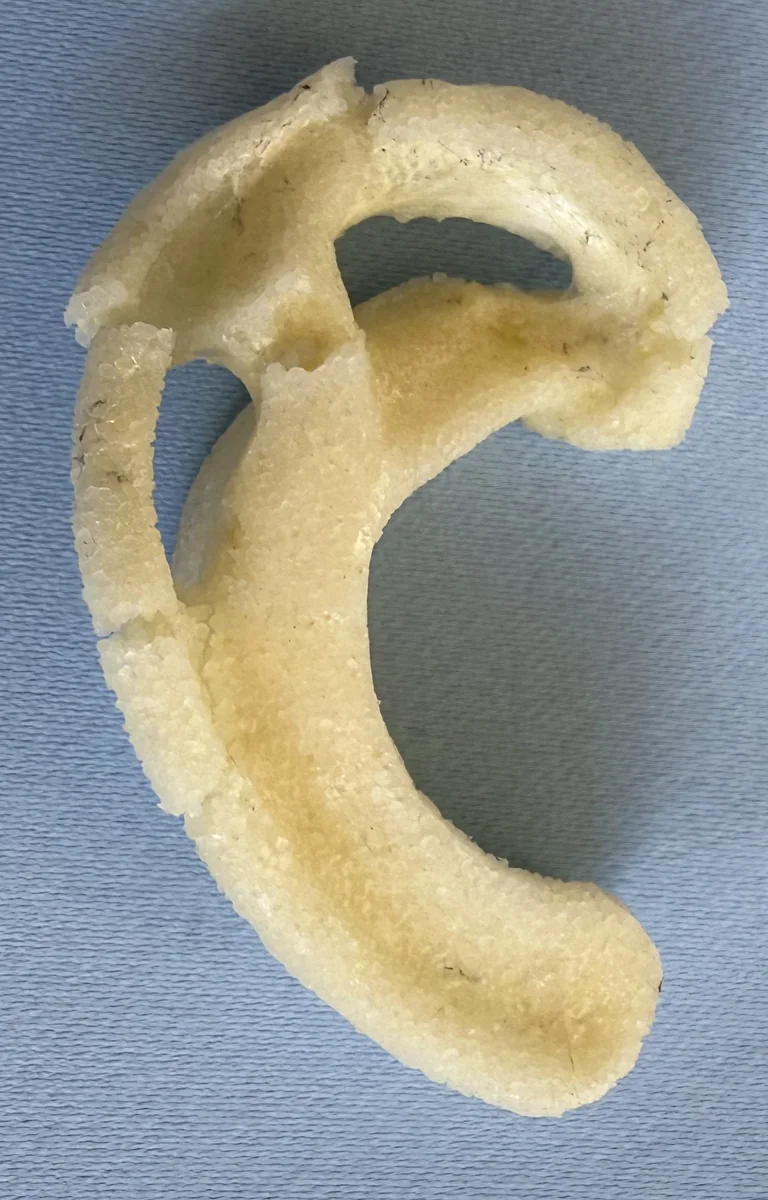
Families in this situation deserve honest information about what the tissue assessment shows. In some cases, meaningful reconstruction remains possible. In others, prosthetic reconstruction — a custom-fitted external ear prosthesis — may be the most realistic path to a natural appearance, and it is one that can produce genuinely good results when properly fitted.
The comparison between rib cartilage and synthetic approaches is addressed in depth on our Cartilage vs. Medpor page. For families who have already had implant surgery and are dealing with complications, the priority is clinical evaluation — not retrospective comparison.
What to Ask at a Revision Consultation
A revision consultation is not the same as a first-time consultation. The questions that matter are different, and the answers will be more specific to the clinical situation in front of the surgeon. These are the questions worth asking.
- What specifically can be improved, and what cannot? An experienced surgeon will be direct about both. Vague promises of improvement are not sufficient — you need to understand what the realistic goals are.
- What is the condition of the remaining tissue? Tissue quality, vascularity, and the presence of scarring are the most important factors in revision. Ask for a frank assessment.
- How many revision cases like this have you personally treated? Revision surgery requires a different skillset than primary surgery. Volume and experience specifically in revision cases matter.
- What options remain if this revision procedure is needed again in the future? Preserving future options matters in revision just as it matters in primary surgery. Understand what the proposed intervention will leave available.
- What would you do if this were your child? A surgeon who has spent years in this field has seen the full range of outcomes. Their candid answer to this question is often the most valuable information in the room.
- Is prosthetic reconstruction a realistic option for this situation? A prosthetic ear can be an excellent solution in certain revision scenarios. An honest surgeon will raise this option if it is appropriate rather than proceeding with surgical revision regardless.
You can also review our full questions guide for additional guidance on evaluating any microtia surgeon — many of the principles apply equally in revision consultations.
What I Tell Families in These Situations
When a family comes to me after a prior reconstruction that did not go as hoped, the first thing I tell them is this: the fact that you are here, asking these questions, is exactly right. Complex situations do not resolve themselves with time. They require expert evaluation, honest information, and a realistic plan.
The second thing I tell them is that not every problem can be fully erased. Some complications leave permanent changes to the tissue that no surgical intervention can completely undo. I say this not to take away hope, but because false promises are the most damaging thing a surgeon can offer a family that is already in a difficult place. Clarity is more valuable than reassurance.
Many problems can be meaningfully improved. Not every problem can be fully corrected. The job of a surgeon in a revision consultation is to tell the truth about which situation this is — and then, if improvement is possible, to explain exactly what that improvement might look like and what it will require.
The third thing I tell families is that revision surgery requires a different kind of judgment than primary surgery. Technical skill matters, but surgical judgment — knowing what to do, what not to do, when to operate and when to wait — matters more in revision cases than anywhere else in this field. A surgeon who has seen a wide range of revision outcomes develops a calibration that simply cannot come from training alone.
Finally, I tell families that even in complicated situations, there is almost always a path forward. It may not be the path they hoped for. It may involve managing expectations, accepting what improvement is realistically achievable, or choosing a solution that is different from what they originally imagined. But there is rarely a situation so complex that the family is entirely without options.
For families who would like to review Dr. Bonilla's published clinical record and research, it is available on the publications page. For a review of prior outcomes, the results gallery documents a representative range of cases.
Moving Forward
If your child's prior reconstruction has not produced the result you hoped for, or if you are dealing with a complication that requires expert attention, the most important step is a direct clinical evaluation. Everything that is possible — and everything that is not — becomes clearer once an experienced surgeon has examined the tissue directly.
Photographs and records from prior procedures are helpful but not sufficient on their own. Revision planning requires hands-on assessment of the tissue quality, vascularity, and structural situation that photographs cannot convey.
Whatever has happened before, and however complicated the situation may feel right now, a thoughtful evaluation is the right starting point. Complicated cases deserve the same careful attention as straightforward ones — perhaps more so, because the stakes in getting the assessment right are higher.
If you have questions or would like to request a consultation, Dr. Bonilla's team is available. You can also review the guide to thinking about microtia surgery for broader context on how Dr. Bonilla approaches decisions in this field.