Hearing Options for Your Child
Microtia often means the ear canal is absent — but the inner ear is almost always completely normal. That distinction matters enormously for how hearing can be supported. This page explains every option available to your family, from the first weeks of life through adolescence and beyond. Children with bilateral microtia face unique hearing considerations covered separately.
Why Hearing Intervention Works So Well in Microtia
When parents first learn that their child's ear canal is absent, the concern about hearing is immediate and understandable. Here is the most important thing to know: the hearing system that matters most — the cochlea, the hearing nerve, and the brain — is almost always completely intact and perfectly functional.
The reason hearing is affected in microtia is purely mechanical. Sound cannot travel through an absent ear canal to reach the eardrum and the tiny bones of the middle ear. But the inner ear — the cochlea that converts sound into nerve signals — is almost always normal. It developed from different embryonic tissue, on an earlier timeline, before the developmental disruption that caused microtia occurred.
This type of hearing loss is called conductive hearing loss — a problem with sound conduction, not with the hearing organ itself. The difference matters enormously, because conductive hearing loss is highly treatable. There are several ways to deliver sound to a normal inner ear even when the ear canal is absent.
Why this matters for your child's development
For children with microtia in only one ear (unilateral), the hearing in the normal ear is usually sufficient for language development. For children with microtia affecting both ears (bilateral), some form of hearing support from early infancy is essential — both ears are affected, and language development depends on hearing during those early years.
Hearing loss in microtia is almost always conductive, not sensorineural. This is fundamentally different from the kind of hearing loss that cannot be corrected. In microtia, the problem is a blocked pathway — not a damaged destination. Every hearing option described on this page is designed to bypass that blocked pathway and deliver sound to a cochlea that is fully functional and capable of receiving it.
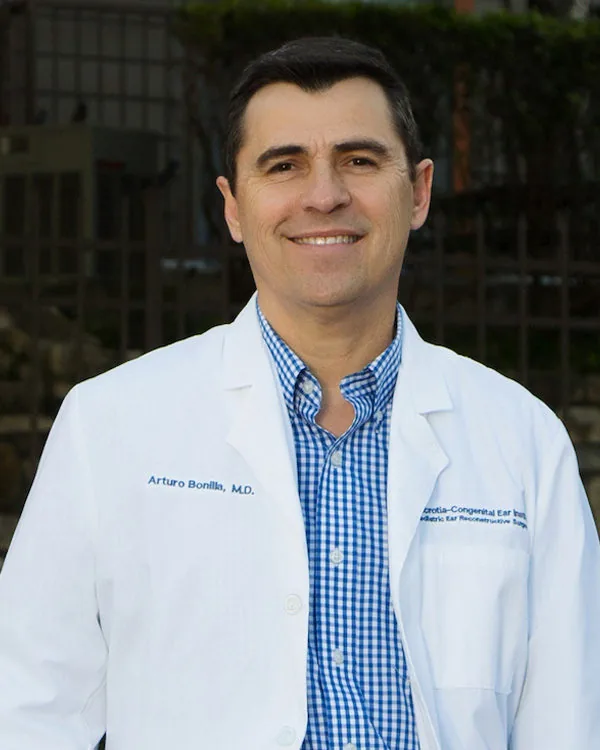
Dr. Bonilla explains how to read a hearing test and audiogram for microtia patients.
For children born with microtia in only one ear — unilateral microtia — no hearing intervention is a genuinely valid option. Many children with unilateral microtia and aural atresia hear perfectly well through their normal ear, develop language on schedule, perform well academically, and live completely normal lives without any hearing device.
Years ago, no intervention was common because the risks of canal surgery (particularly to the facial nerve) were poorly understood and difficult to predict. Even now, with dramatically improved CT imaging and facial nerve monitoring, the decision to pursue any hearing intervention for a unilateral child is never a medical urgency — it is a family choice.
Dr. Bonilla respects that choice completely. A child should never be pressured into hearing intervention they don't want or aren't ready for. Some families choose to wait and let the child participate in the decision when they are older. Others pursue hearing support early. Neither choice is wrong.
What families choosing no intervention should know
Even without a hearing device, children with unilateral microtia benefit from awareness of their single-sided hearing. Classroom seating (hearing ear toward the teacher), awareness of cars approaching from the side with hearing loss, and informing teachers and coaches of the situation are practical steps that make a real difference.
Regular audiological monitoring is also worth considering — periodic hearing tests to confirm the normal ear remains healthy and that no unexpected changes have occurred.
Important: No intervention is only a valid option for unilateral microtia. Children with bilateral microtia — microtia affecting both ears — have significant hearing loss on both sides. For bilateral children, some form of hearing support from early infancy is not optional — it is essential for language development, learning, and communication. Dr. Bonilla's team will discuss hearing devices urgently for bilateral families.
A bone-conduction hearing device uses a simple but remarkable principle: rather than sending sound through the ear canal (which is absent), it vibrates the skull bone directly. Those vibrations travel through the skull to the cochlea — bypassing the absent ear canal and middle ear entirely. The cochlea receives the signal just as it would from airborne sound through a normal canal.
In its non-surgical form, the sound processor clips onto a soft elastic headband worn on the head. This is the softband — an elastic band with a small plastic snap that holds the processor snugly against the temporal bone just behind where the ear would be. No incision. No implant. No surgery of any kind.
Softband devices can be fitted from the first weeks of life. For bilateral microtia families, fitting should happen as early as possible — within the first few months. For unilateral families who choose to use one, timing is more flexible, but earlier is generally better for language development during the critical early years.
What the softband feels like
The headband is soft, flexible, and adjustable. Most infants and toddlers adapt to wearing it quickly. The processor itself is small — roughly the size of a large button — and sits flat against the head. It can be worn under a hat or hair. Many children wear theirs comfortably all day.
How long does a child use a softband?
Most children use a softband device until around age 4–5, when surgical implantation of a bone-conduction device becomes an option. Some children continue with softband devices longer depending on preference, anatomy, or whether the family chooses to pursue surgical placement at all. The softband can also be used throughout adulthood — it remains a valid long-term solution if surgical options are not pursued.
The softband device is the immediate first step for bilateral microtia families. Dr. Bonilla's team will coordinate with an audiologist to fit a softband device as soon as possible after birth for bilateral cases. Coverage for bone-conduction devices varies by insurance plan — Dr. Bonilla's team can assist families with documentation and pre-authorization as needed.
- No surgery, no anesthesia
- Available from birth
- Immediate hearing improvement
- Upgrades to surgical device later
- Usually covered by insurance
- Adjustable and removable
- Must be worn daily — not permanent
- Can slip or fall off in young children
- Sound quality slightly reduced vs. surgical
- Headband visible in some hairstyles
- Requires care and maintenance
The First Time a Child with Microtia Hears Clearly
Children with microtia are almost always born with a normal cochlea — the hearing organ itself is intact and functioning. The only barrier to hearing is the absent or malformed ear canal. A bone conduction device bypasses that barrier entirely, transmitting sound through the skull directly to the inner ear.
The result is immediate. There is no adjustment period. The child hears — clearly, fully — the moment the device is turned on.
This is available from birth. The bone-conduction device shown in this video shows the parents that a bone-conduction softband can be fitted in the first weeks of life — before any discussion of surgery, before any decisions need to be made.
A young girl with microtia smiles and claps the moment a bone conduction device is placed behind her ear — her first experience of clear sound.
When a child is around 4–5 years of age and has sufficient skull bone thickness, a small titanium implant can be placed in the skull bone behind the ear. The sound processor attaches directly to this implant — either via an external abutment (a small post that protrudes through the skin) or magnetically through intact skin. The bone-conduction principle is identical to the softband, but the coupling is direct: vibration transfers more efficiently, and sound quality is noticeably improved.
The surgery itself is relatively brief and minor — far simpler than ear reconstruction or atresiaplasty. It is typically performed under general anesthesia as an outpatient procedure and takes less than an hour. Recovery is straightforward, and the device can be activated within a few weeks.
Percutaneous vs. transcutaneous (magnetic) systems
Percutaneous (abutment-based) systems — such as the older Cochlear Baha Connect — place a small titanium abutment through the skin. The processor clips directly onto the abutment. This provides the most efficient sound coupling and the best hearing outcomes, but requires daily skin care around the abutment site and carries a small risk of skin reaction or infection at the site.
Transcutaneous (magnetic) systems — such as the Cochlear Cochlear Osia, Oticon Sentio, or MED-EL Bonebridge — use a magnet implanted under intact skin. The processor attaches magnetically through the skin with no external abutment. The skin remains closed, eliminating the abutment site care. There is a small reduction in sound efficiency due to transmission through skin, but it is clinically minimal for most patients, and the aesthetic and care advantages are significant.
Who performs this surgery?
Bone-conduction implant placement requires a board-certified ENT (otolaryngologist) surgeon with training in skull base surgery and hearing devices. Dr. Bonilla strongly believes that bone-conduction implant surgery should only be performed by ENT surgeons specifically trained in hearing disorders and capable of managing any intraoperative complications. His team maintains relationships with experienced ENT colleagues and will provide referrals for families who need them.
Relationship to ear reconstruction
The placement of a bone-conduction implant and ear reconstruction can be coordinated carefully. Implant placement should be discussed in the context of the reconstruction plan, as the implant position must be chosen so it does not interfere with the surgical field for ear reconstruction. Dr. Bonilla's team will coordinate this timing with the ENT surgeon to ensure both procedures can proceed optimally.
- Better sound quality than softband
- No daily headband to wear
- More natural to children's daily life
- Minor surgery, outpatient
- Processor still removable/upgradeable
- Magnetic options — no external post
- Requires surgery and anesthesia
- Minimum skull thickness needed (age 4–5+)
- Abutment systems need daily skin care
- Small risk of infection or skin reaction
- Implant timing must coordinate with ear reconstruction plan
Atresiaplasty is the only option that addresses the root cause of hearing loss in microtia — the absent ear canal — directly. The surgeon uses a specialized drill to create a new canal through the temporal bone, then places a skin graft to line the new canal and constructs a new eardrum (tympanic membrane). When successful, the result is natural, air-conducted hearing through a real ear canal — no device required.
This is a complex surgery that should only be performed by an experienced otologist (a physician specializing in ear surgery). The results depend heavily on the individual anatomy of the middle ear — the position of the ossicles, the development of the mastoid air cells, and especially the course of the facial nerve — all of which are evaluated beforehand with a high-resolution CT scan of the temporal bone.
CT scan — the essential first step
Before atresiaplasty can even be considered, a high-resolution CT scan of the temporal bone is performed. This gives the surgeon a detailed map of the middle ear anatomy and allows accurate assessment of:
- Middle ear and mastoid pneumatization — how well air cells have developed in the mastoid bone (larger is better)
- Ossicular anatomy — the shape, position, and mobility of the malleus, incus, and stapes
- Inner ear morphology — confirming the cochlea is normal
- Facial nerve course — the facial nerve runs through the temporal bone near the surgical field; its position must be known precisely before surgery
Based on the CT findings, each patient is graded as a good, moderate, or poor candidate for atresiaplasty. Poor candidates — those with highly unfavorable anatomy — should not undergo the surgery, as the risk of complications outweighs the potential hearing benefit.
The most important risks
Re-narrowing (stenosis) of the new canal is the most common long-term issue — the new canal can scar and gradually narrow over time, reducing hearing and sometimes requiring revision. Keeping the canal open may require periodic cleaning and ear drops long-term.
Facial nerve injury is the most serious risk. The facial nerve controls all movement of the face, and it runs near the surgical field. In experienced hands with proper CT planning and intraoperative facial nerve monitoring, the risk should be low — but it is not zero, and this is precisely why atresiaplasty should only be performed by surgeons with specific training and substantial experience in this procedure.
How atresiaplasty relates to ear reconstruction
Timing and sequencing of atresiaplasty relative to outer ear reconstruction is critically important. Ear reconstruction typically comes first — the intact skin at the ear site is essential for reconstruction, and atresiaplasty alters that skin. In most cases, the sequence is: complete all stages of ear reconstruction, then consider atresiaplasty if the anatomy warrants it and the family wishes to pursue it. Dr. Bonilla and the treating otologist will discuss this sequencing together to develop the right plan for each child.
Dr. Bonilla explains atresiaplasty — ear canal surgery for microtia patients with aural atresia.
- Natural hearing — no device to wear
- Can achieve near-normal hearing in good candidates
- No ongoing device batteries or maintenance
- Hearing improved for life if canal stays open
- Complex surgery — facial nerve risk
- Not all patients are candidates
- Canal re-narrowing is common long-term
- Requires ongoing ear canal maintenance
- Hearing outcome less predictable than device
- Must be sequenced after ear reconstruction
All Hearing Options at a Glance
This table covers the most important practical factors. Every family's situation is different — use this as a starting point, not a final answer.
| Factor | No Intervention | Softband Device | Surgical BC Device | Atresiaplasty |
|---|---|---|---|---|
| Available from | Birth | Birth (weeks old) | Age 4–5+ | Age 6+ (after reconstruction) |
| Surgery required | None | None | Minor (outpatient) | Major (specialist) |
| Device worn daily | None | Yes — softband | Processor only (no band) | None if successful |
| Hearing quality | One-ear hearing only | Good (through skull) | Very good | Near-normal in good candidates |
| Suitable for bilateral | No — not appropriate | Yes — first option | Yes | Case by case |
| CT scan required | No | No | No | Yes — essential |
| Risk of facial nerve | None | None | Very low | Present — low in expert hands |
| Coordinates with ear reconstruction | N/A | Yes — no interference | Timing coordination needed | Must come after reconstruction |
| Long-term maintenance | Monitoring only | Device care, battery | Device care, battery; minimal abutment care | Canal cleaning; possible revision |
Which Hearing Option Is Right for My Child?
The answer depends on several factors — whether microtia is unilateral or bilateral, the child's age, their CT anatomy, and what your family values most. Here is a practical guide.
Your child has one normal hearing ear. Language development typically proceeds normally. You have genuine options — including no intervention at all.
If your child is developing language normally and shows no signs of struggle, observation is entirely reasonable. Many unilateral children thrive without any device.
If you would like hearing support — for school, for safety awareness, for improved hearing in noisy environments — a softband device provides good bilateral sound without any surgery or commitment. Many families start here.
When your child is 4–5+, a surgical bone-conduction device becomes an option and provides better sound quality with no daily headband. The decision to pursue it depends on your child's preference and your family's values.
Atresiaplasty requires careful CT assessment. It is not appropriate for every patient and must be sequenced carefully with ear reconstruction. It is rarely the first or urgent recommendation for a unilateral child.
Your child has significant hearing loss in both ears. Hearing support is not optional — it is necessary for language development, learning, and communication. Please do not delay.
From birth: a softband bone-conduction device should be fitted as soon as possible — within the first months of life. Both Cochlear and Oticon offer softband systems that can be fitted in newborns. Dr. Bonilla's team will connect you with an audiologist immediately.
Around age 4–5: the transition to a surgically placed bone-conduction device provides meaningfully improved sound quality and removes the daily headband. For bilateral children, implants on both sides may be discussed.
Atresiaplasty for bilateral children is evaluated on each side individually, with CT assessment of each ear's anatomy. Whether and when to pursue canal surgery on one or both sides is a detailed discussion with Dr. Bonilla and an experienced otologist.
The most important message for bilateral families: start hearing support now. Every week of early hearing intervention during the language development window matters.
These timelines are typical, not mandatory. Some children get surgical bone-conduction devices before reconstruction. Some families pursue atresiaplasty immediately. Some choose softband devices for life. Dr. Bonilla's team will work with your family's specific situation to develop a plan that makes sense for your child — not a protocol designed for the average patient.
To get started, submit your information through our contact form and Dr. Bonilla’s team will be in touch to schedule a virtual consultation.
Questions Families Ask About Hearing Options
If your child has bilateral microtia, contact Dr. Bonilla's office and request an urgent referral to an audiologist who fits softband bone-conduction devices. Fitting should happen within the first few months of life. Language development in the critical early years depends on hearing input, and a softband device provides that safely and immediately — no surgery, no waiting.
If your child has unilateral microtia, the timeline is less urgent because the normal ear provides hearing. Schedule a consultation with Dr. Bonilla to discuss your options at your own pace. There is no emergency for unilateral cases, and no decision needs to be made in the immediate days after diagnosis.
In both cases: a newborn hearing screening (ABR — auditory brainstem response) will likely be performed in the hospital. This tests whether the cochlea and hearing nerve are functioning — which they almost always are in microtia. Confirm that the ABR was performed and discuss the results with your pediatrician.
A softband hearing device does not interfere with ear reconstruction at all — the headband is removed and replaced as needed, and no surgery is involved. Softband devices can be used before, during, and after all stages of ear reconstruction without any conflict.
A surgically placed bone-conduction device requires more careful coordination. The implant position must be chosen with the ear reconstruction plan in mind — specifically, the implant should not be placed in or near the surgical field used for reconstruction. Dr. Bonilla discusses this with families and communicates with the ENT surgeon to ensure the implant is placed in a location that doesn't compromise the reconstruction work.
Atresiaplasty must come after ear reconstruction is complete. The skin at the ear site is used in reconstruction, and atresiaplasty alters that skin — so the sequence matters. Dr. Bonilla will not recommend atresiaplasty before reconstruction stages are complete.
No, it is not too late. The urgency for hearing intervention is greatest in the first 3–5 years of life for language development purposes. But hearing benefits at any age, and starting a bone-conduction device at age 7, 10, or even adulthood provides real improvement in hearing access, academic performance, situational awareness, and quality of life.
At age 7, a surgically placed bone-conduction device is a good option if the family wishes to pursue it — the skull bone is well-developed, and the procedure is straightforward. A softband device is also still an option if surgery is not desired.
If your child has never had hearing assessment, an ABR or standard audiogram is a good starting point to document the current hearing status in both ears. This gives the audiologist and Dr. Bonilla's team a baseline to work from.
The only way to determine atresiaplasty candidacy is with a high-resolution CT scan of the temporal bone, interpreted by an experienced otologist. The CT reveals the anatomy of the middle ear — mastoid development, ossicular anatomy, facial nerve course, and inner ear morphology. These findings together determine whether creating a functional ear canal is surgically feasible and likely to produce a meaningful hearing improvement.
If you are interested in exploring atresiaplasty, Dr. Bonilla can order the CT scan and refer you to a specialist otologist who will provide the candidacy assessment. This should be discussed in the context of the ear reconstruction plan, as the sequencing matters.
Not every patient is a candidate — and for those who are not, bone-conduction devices provide excellent hearing with none of the surgical risks. An honest candidacy assessment is always better than proceeding with a surgery that is unlikely to improve hearing meaningfully.
Yes, in most cases. Bone-conduction hearing devices for microtia patients — both softband and surgical — are typically covered by insurance because microtia and aural atresia are well-documented medical diagnoses with established hearing loss. Coverage is often better than many families expect.
The coverage process does require documentation of the diagnosis, the audiological findings, and the medical necessity. Dr. Bonilla's team and the audiologist will provide the necessary documentation to support the insurance claim. State Medicaid programs also typically cover these devices for pediatric patients.
If you have concerns about coverage, Dr. Bonilla's office can provide a pre-authorization letter and coordinate with your insurer before any fitting or procedure is scheduled. Hearing device access should not be limited by insurance confusion — Dr. Bonilla's team will help navigate this.
Yes. Softband devices are worn on an elastic headband and can be worn during most daily activities including sports. The headband can be worn under a helmet for activities like cycling or team sports, and many children find it barely noticeable during play. For swimming, the processor is removed before entering the water — bone-conduction processors are not waterproof (though some newer models have water-resistance ratings for splashing).
Surgically placed bone-conduction devices, once healed, are similarly compatible with active lifestyles. The processor is removed for swimming and contact sports, and replaced for daily activities. Most children adapt quickly and don't think about it much.
Finding the Right Hearing Approach for Your Child
Whether your child needs hearing support from day one or you’re exploring options for the first time years later, Dr. Bonilla’s team will walk through every option with you — tailored to your child’s specific anatomy, age, and circumstances — and connect you with the right specialists at the right time.