When Both Ears Are Affected — A Guide for Bilateral Families
Bilateral microtia — microtia affecting both ears — occurs in approximately 10% of microtia cases. It requires more urgent action than unilateral microtia, particularly around hearing. But with the right support from the very beginning, children with bilateral microtia can achieve functional hearing with appropriate devices, normal speech development with early support, and reconstruction of both ears is possible for eligible patients.
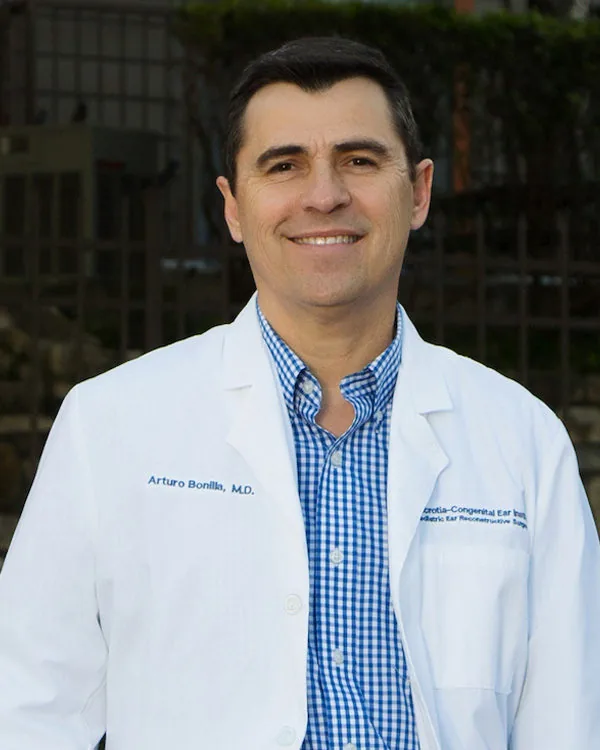
Medically reviewed by Arturo Bonilla, MD — August 2026
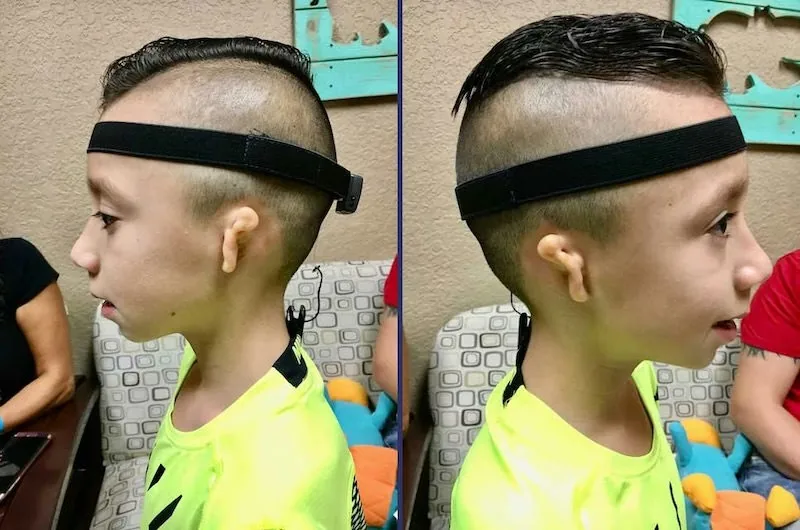
Bilateral microtia — both ears affected before reconstruction surgery.
Bilateral microtia affects both ears simultaneously — yet with the right surgical planning, both ears can be reconstructed to achieve a natural, balanced, and symmetrical result.
What bilateral microtia means — and what it does not mean
The diagnosis
Bilateral microtia is the condition in which both external ears have not developed normally. It accounts for approximately 10% of all microtia cases, making it significantly rarer than unilateral microtia (one ear affected, ~90% of cases). The grade of microtia on each side does not have to match — one ear may be Grade II while the other is Grade III, for example. The left and right ears develop somewhat independently, and each follows its own developmental trajectory.
Bilateral microtia is more commonly associated with a genetic or syndromic cause than unilateral microtia. This does not mean every bilateral case is syndromic — isolated bilateral microtia without any associated features does occur — but families of bilateral children should expect a genetics evaluation to be recommended. In many cases the evaluation is reassuring, confirming no identifiable syndrome.
The fundamental principles of bilateral microtia are the same as unilateral: the outer ear has not fully developed, the ear canal is typically absent on both sides, and the inner ear (cochlea) is almost always normal. What changes in the bilateral case is the scope of the hearing impact and the urgency of intervention.
What bilateral microtia is not
Bilateral microtia is not deafness. The cochlea — the organ responsible for converting sound waves into nerve signals — is almost always normally formed in bilateral microtia. The hearing loss is conductive: sound cannot get through the absent outer ear and ear canal, but the receiving machinery is intact. This is an enormously important distinction because conductive hearing loss is bypassable. A bone conduction hearing device sends sound vibrations through the skull directly to the cochlea, circumventing the absent canal entirely. Early bone conduction support can improve access to sound; individual outcomes vary.
Bilateral microtia is also not a barrier to reconstruction. Both ears can be rebuilt using rib cartilage with the same two-stage protocol used for unilateral full-ear reconstruction. Dr. Bonilla coordinates the stages across three surgical visits over approximately four months.
Associated conditions and genetics
Bilateral microtia has a higher rate of associated syndromic features than unilateral microtia. The most common associated syndromes include Treacher Collins syndrome (bilateral facial underdevelopment including both ears, jaw, and cheekbones), Goldenhar syndrome / oculo-auriculo-vertebral spectrum (typically asymmetric but may be bilateral), and CHARGE syndrome (involving multiple organ systems). When bilateral microtia is identified, a clinical genetics evaluation and broader workup — including renal ultrasound, ophthalmology evaluation, and craniofacial assessment — is appropriate. In many bilateral cases, these evaluations return normal results and the microtia is isolated.
How bilateral microtia differs from unilateral — and why it matters
The difference is not just about numbers. Bilateral microtia creates a qualitatively different challenge — particularly for hearing — that requires a different level of urgency and a different approach to management.
- ●The normal opposite ear provides full auditory input to both hemispheres of the brain
- ●Speech and language development proceeds on a normal timeline in the vast majority of cases
- ●Hearing support is individualized in consultation with pediatric audiology
- ●Hearing intervention is important but not time-critical in the first weeks of life
- ●Challenges: directional hearing, listening fatigue in noise — significant but manageable
- ●Reconstruction: one ear, one or two stages depending on grade
- ●Genetics workup: optional unless family history or other features present
- ●Without support, no adequate auditory input reaches the brain — the language development window closes
- ●Speech and language delay is virtually inevitable without hearing intervention
- ●For infants with bilateral microtia and aural atresia, Dr. Bonilla recommends a softband bone-conduction device within the first two months after birth
- ●Hearing intervention is the single most urgent medical priority after birth
- ●Early hearing support can support normal language development; individual outcomes vary
- ●Reconstruction: three coordinated surgical visits completed in approximately four months
- ●Genetics workup: strongly recommended — higher syndromic association
The First Weeks of Life — Hearing Priorities and What to Do
The language acquisition window
The human brain is most receptive to language learning in the first three years of life — and most critically, in the first twelve months. During this period the brain is actively constructing the neural architecture for language: building phonological categories, establishing syntactic patterns, laying down the semantic networks that will underlie all future communication. It does this by listening — constantly, from the first hours after birth.
In a child with bilateral microtia and no hearing support, essentially no sound reaches the cochlea through normal air conduction. The auditory cortex receives minimal input. It does not wait patiently — it begins to repurpose neural resources that would have been devoted to auditory language processing. Once this repurposing occurs, even excellent hearing technology introduced later produces diminished results compared to what early intervention achieves. This is the neuroscience behind the urgency. It is not alarmism — it is the window closing.
What bone conduction solves
A bone conduction hearing device placed on a softband headband transmits sound vibrations through the skull bones directly to the cochlea — bypassing the absent outer ear and canal entirely. With early hearing support and appropriate audiology follow-up, children with bilateral microtia can achieve normal speech and language development, but individual outcomes vary. No hearing device guarantees normal hearing, sound localization, or every language milestone.
The BAHA softband is a non-surgical device — no anesthesia, no procedure, no waiting for skull development. For infants with bilateral microtia and aural atresia, Dr. Bonilla recommends fitting a softband bone-conduction device within the first two months after birth. It looks like a padded headband with a small sound processor. It is comfortable, washable, and adjustable. With early hearing support and appropriate audiology follow-up, children with bilateral microtia can achieve normal speech and language development, but individual outcomes vary. No hearing device guarantees normal hearing, sound localization, or every language milestone.
The consequences of delayed support
Bilateral microtia families who do not receive early referral for audiology — or who wait to see how language develops before seeking support — may find, at age two or three, that their child has fallen behind in vocabulary, sentence length, and phonological awareness. This delay is catchable, but it requires more intensive speech-language therapy and the window for fully natural catch-up narrows with time. Every week of support in the first year matters more than a month of support at age four. For infants with bilateral microtia and aural atresia, Dr. Bonilla recommends fitting a softband bone-conduction device within the first two months after birth. With early hearing support and appropriate audiology follow-up, children with bilateral microtia can achieve normal speech and language development, but individual outcomes vary. No hearing device guarantees normal hearing, sound localization, or every language milestone.
The Moment Everything Changes
These are real children with microtia hearing clearly for the first time with a bone conduction device. This is what early hearing intervention looks like — and why it cannot wait.
A baby boy in a carrier stops crying the instant a bone conduction device is placed on his forehead.
A baby boy held by his dad stops crying immediately when a bone conduction device is placed over his right microtia ear.
In children with microtia, the inner ear and hearing nerve are almost always normal. The bone conduction device bypasses the absent ear canal and delivers sound directly to the inner ear. For infants with bilateral microtia and aural atresia, Dr. Bonilla recommends fitting a softband bone-conduction device within the first two months after birth.
The three pathways to hearing — and which applies when
Bilateral microtia families typically move through hearing interventions in a sequence. The softband is first. Surgical options come later. Each decision is made individually based on the child’s anatomy and development.
How Dr. Bonilla approaches bilateral reconstruction
Coordinated Staging Across Both Ears
Visit 1 — Stage 1 on Ear 1. Visit 2 — Stage 2 on Ear 1 + Stage 1 on Ear 2 under the same anesthesia. Visit 3 — Stage 2 on Ear 2. Total: 3 surgical visits, approximately 4 months.
The cartilage for each ear is harvested from ribs 6, 7, and 8 on the side of the chest opposite the ear being reconstructed — a separate harvest for each ear, performed during that ear’s Stage 1. The incisions are small and both scars tend to fade with time. In Dr. Bonilla’s practice, there have been no functional chest deformities following rib cartilage harvest. He preserves the rib perichondrium on the undersurface to help maintain chest-wall integrity during healing.
Which ear goes first
The decision of which ear to reconstruct first is made at consultation, considering: the grade of each ear (the more severe presentation may benefit from more planning time while the less complex side is done first, or vice versa depending on clinical factors); the child’s ear anatomy and skull development; and in some cases, the child’s and family’s preference. There is no single rule. What is consistent: both ears will be reconstructed, both will be given the same level of care and precision, and the sequencing serves the best possible bilateral result.
The role of the existing tissue
In Grade III bilateral cases, each ear may have a cartilage remnant and a displaced earlobe. During Stage 1 for each ear, the framework is placed, the earlobe is rotated into position, the tragus is formed, and the concha is deepened. In Grade IV anotia, the lower portion of the cartilage framework substitutes for the earlobe.
The bilateral microtia timeline from birth through complete reconstruction
Dr. Bonilla’s coordinated bilateral sequence uses three surgical visits over approximately four months. This table shows the full picture.
| Period | Hearing priority | Surgical milestone | What parents focus on |
|---|---|---|---|
| Birth — first 2 months | ⚡ Prompt ABR test; softband fitting within the first two months | Consultation with Dr. Bonilla | Audiology referral, BAHA fitted, genetics workup initiated |
| Months 1–12 | Full-time BAHA wear — critical language window | Intermittent evaluation to monitor hearing | BAHA worn daily; language milestones monitored; annual ENT and audiology visits |
| Ages 1–5 | Continued BAHA softband use | Yearly communication with Dr. Bonilla | Normal childhood; building confidence; school preparation; exploring surgical questions |
| Age ~6–7 | BAHA continues; CT scan for atresia candidacy if desired | ✅ Ear #1 Stage 1 — complete ear structure | Overnight recovery and drain follow-up for Ear #1 |
| ~2 months later | BAHA softband continues | ✅ Ear #1 Stage 2 & Ear #2 Stage 1 | Ear #1 elevation; Stage 1 recovery for Ear #2 |
| ~2 months later | BAHA continues | ✅ Ear #2 Stage 2 — bilateral reconstruction complete | Ear #2 elevation complete; optional BAHA placement; both ears fully reconstructed |
What Bilateral Reconstruction Achieves
Questions bilateral families ask
These are the questions Dr. Bonilla hears most consistently from bilateral microtia families at first consultation.
Immediately — today if possible. The newborn hearing evaluation (ABR test) should occur promptly. For infants with bilateral microtia and aural atresia, Dr. Bonilla recommends fitting a softband bone-conduction device within the first two months after birth. Do not wait for a scheduled well-baby visit. Call your pediatrician and request an urgent audiology referral specifically noting bilateral microtia and the need for bone conduction device fitting. The language development window is open right now and every week counts.
The BAHA softband is a padded elastic headband with a small sound processor — similar in appearance to noise-cancelling headphones worn on top of the head. Infants and young children adapt to it quickly, typically within days. It is adjustable, washable, and designed for infant use. Many children wear it without any apparent discomfort throughout their waking hours. Most families report that by a few weeks in, the child protests when it is removed rather than when it is put on — a reliable sign that it is providing beneficial auditory input.
With early hearing support and appropriate audiology follow-up, children with bilateral microtia can achieve normal speech and language development, but individual outcomes vary. No hearing device guarantees normal hearing, sound localization, or every language milestone.
Yes. Each ear’s framework is carved from the child’s own rib cartilage, with a separate harvest for each ear — always taken from the side of the chest opposite the ear being reconstructed, during that ear’s Stage 1. The incisions are small and both scars tend to fade with time. In Dr. Bonilla’s practice, there have been no functional chest deformities following rib cartilage harvest. He preserves the rib perichondrium on the undersurface to help maintain chest-wall integrity during healing. The ears are reconstructed in separate but coordinated surgical visits.
Visit 1 — Stage 1 on Ear 1. Visit 2 — Stage 2 on Ear 1 + Stage 1 on Ear 2 under the same anesthesia. Visit 3 — Stage 2 on Ear 2. Total: 3 surgical visits, approximately 4 months.
This depends entirely on the child’s middle ear anatomy, assessed by CT scan. Atresiaplasty in bilateral microtia requires careful evaluation because the facial nerve is in close proximity to the surgical field on both sides, and the risk-benefit calculation is different from unilateral cases. When anatomy is highly favorable on one or both sides, canal surgery can provide meaningful hearing improvement that reduces or eliminates lifelong dependence on an external device. When anatomy is less favorable, BAHA provides equivalent functional hearing with substantially less surgical risk. Dr. Bonilla will discuss the CT findings and candidacy at your consultation. Many bilateral families ultimately find that BAHA meets their hearing needs well and opt not to pursue canal surgery.
Yes — with a brief exception immediately after each surgical stage. Dr. Bonilla will give specific activity restrictions for the first 4–6 weeks after each stage (typically: no contact sports, no swimming, no activities with risk of impact to the head or ear). Once each recovery period ends, all activities resume normally. Between stages, children participate fully in sports, swimming, PE, and all physical activities. The rib cartilage framework is durable and not fragile once healed. By the time reconstruction is complete, both ears are safe for all activity including contact sports.
Related Resources for Bilateral Families
Outcomes and Next Steps
Bilateral microtia is more involved than unilateral — but both ears are fully reconstructible, and early hearing support protects speech and language development. Dr. Bonilla’s team supports families through every stage of this process. Telehealth is available worldwide.