Is My Child Ready for Microtia Surgery?
Deciding whether and when to pursue microtia reconstruction is a significant decision. This page covers the primary factors in that assessment — age, rib cartilage development, body size, microtia grade, prior surgeries, and revision cases. Surgery is a choice, not an obligation.
3D ear reconstruction using the child’s own rib cartilage requires enough rib growth to sculpt a complete ear framework. Dr. Bonilla usually recommends reconstruction at 6–9 years of age, depending on the patient’s height and the size of the opposite ear. This is not a limited surgical window, and older patients have not necessarily missed the opportunity. Readiness is assessed individually.
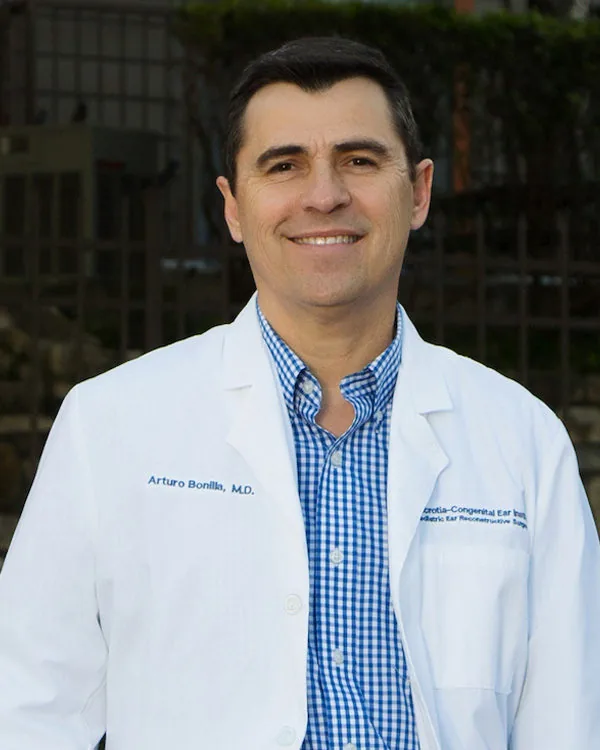
Medically reviewed by Arturo Bonilla, MD — August 2026
When a child is not ready — physically or psychologically — Dr. Bonilla's recommendation is to wait. The consultation outcome is not always 'schedule surgery.' It is sometimes 'come back when your child is ready,' and that outcome is treated as equally valid.
The psychological readiness of the child matters as much as the physical readiness. A child who understands what is happening, who has some ownership of the decision, and who is cooperative with post-surgical care has meaningfully better outcomes — not just emotionally, but clinically. A child who is frightened, ambivalent, or resistant is not a good surgical candidate regardless of their age or anatomy.
Surgery Is a Choice, Not a Requirement
Many parents arrive at a consultation having already decided that surgery is what they want for their child. Some arrive uncertain. Some arrive having been told by someone else that their child “needs” surgery urgently, before a certain age, before school starts, before teasing begins.
The decision to pursue microtia reconstruction belongs to the family — and ultimately, to the child. There is no medical or social urgency that justifies proceeding before a child is physically and psychologically ready.
Children live with microtia without surgery. They have full lives, form friendships, achieve academically, participate in sports, and thrive — with or without reconstruction. Microtia is a physical variation, not a medical emergency. Surgery is a meaningful and often profoundly positive choice. It is not the only acceptable one.
What “ready” actually means
Readiness for microtia surgery has two dimensions that must both be present:
- Physical readiness — sufficient rib cartilage development, appropriate body size, good general health
- Psychological readiness — the child understands what surgery is, expresses genuine interest in having an ear, and is cooperative with the surgical and recovery process
Neither dimension can substitute for the other. A physically ready child who is frightened or resistant is not ready. A child who desperately wants an ear but whose rib cartilage hasn’t sufficiently developed needs to wait a little longer. Both conditions must be met — and the child’s own voice in that assessment matters.
Dr. Bonilla usually recommends reconstruction at 6–9 years of age, depending on the patient’s height and the size of the opposite ear. This is not a limited surgical window, and older patients have not necessarily missed the opportunity. Readiness is assessed individually.
The Recommended Age Range — and Why It Exists
Dr. Bonilla usually recommends reconstruction at 6–9 years of age, depending on the patient’s height and the size of the opposite ear. This is not a limited surgical window, and older patients have not necessarily missed the opportunity. Readiness is assessed individually.
Why readiness is assessed individually
The limiting factor is not skill, equipment, or philosophy — it is rib cartilage. A child’s costal cartilage (the cartilage connecting the lower ribs to the breastbone) must be sufficiently developed and proportioned to provide enough material to carve a complete ear framework that will look correct on an adult face.
Dr. Bonilla usually recommends reconstruction at 6–9 years of age, depending on the patient’s height and the size of the opposite ear. This is not a limited surgical window, and older patients have not necessarily missed the opportunity. Readiness is assessed individually.
Dr. Bonilla usually recommends reconstruction at 6–9 years of age, depending on the patient’s height and the size of the opposite ear. This is not a limited surgical window, and older patients have not necessarily missed the opportunity. Readiness is assessed individually.
Dr. Bonilla usually recommends reconstruction at 6–9 years of age, depending on the patient’s height and the size of the opposite ear. This is not a limited surgical window, and older patients have not necessarily missed the opportunity. Readiness is assessed individually.
Physical size matters alongside age
Dr. Bonilla assesses rib cartilage development individually — not by age alone. A large, well-developed 6-year-old may have rib cartilage equivalent to an average 8-year-old. A small, slight 7-year-old may need to wait. Age is a useful guideline; the physical assessment at consultation is what actually determines readiness.
The child's participation in the decision
Dr. Bonilla usually recommends reconstruction at 6–9 years of age, depending on the patient’s height and the size of the opposite ear. This is not a limited surgical window, and older patients have not necessarily missed the opportunity. Readiness is assessed individually. He believes the child should have meaningful input into a permanent decision about their own body. A child who is old enough to understand what surgery involves — to ask questions, express their feelings, and participate in the process — arrives at surgery differently than a child who had no say.
The claim that earlier is better because the child will not remember the surgery misses a more important point — a child who has been part of the decision, who understands what is happening and why, has a meaningfully different experience than one who simply had something done to them.
Scheduling is always driven by genuine readiness — not calendar availability.
The Factors Dr. Bonilla Evaluates at Every Consultation
Candidacy for rib cartilage reconstruction is assessed across multiple dimensions. No single factor is a pass/fail — they are weighed together against the individual child.
Prior Surgeries and Failed Reconstruction
Not every family arrives at Dr. Bonilla’s practice starting from scratch. Some are seeking revision after a previous reconstruction was performed elsewhere. Dr. Bonilla evaluates these cases individually — and each requires careful individual assessment.
Dr. Bonilla regularly sees patients who have had prior procedures at other practices — whether a failed first attempt at cartilage reconstruction, a Medpor/Su-Por implant that has extruded or become infected, or a partial reconstruction that was not completed.
Each of these situations is different, and each requires individual assessment of what tissue remains, what skin is available, and what reconstruction options exist. Dr. Bonilla does not assume that prior surgery forecloses further reconstruction — but he will not overstate what is possible either.
The most important factor in revision surgery is the condition of the skin and soft tissue at the ear site. Cartilage reconstruction after a failed Medpor/Su-Por implant is significantly more complex because the fibrovascular ingrowth into the implant affects the skin that would be needed for cartilage reconstruction. Dr. Bonilla assesses this honestly at consultation and gives families an accurate picture of what revision can realistically achieve.
If you are seeking a second opinion or revision assessment, please bring all prior operative reports, photographs, and medical records. The more complete the history Dr. Bonilla has, the more useful and accurate his assessment will be.
Dr. Bonilla is an exclusively pediatric microtia surgeon — his practice treats patients from newborn through age 17. Patients 18 and older are not candidates for surgery with Dr. Bonilla.
However, Dr. Bonilla’s office is happy to speak with adults who have questions about microtia and guide them toward appropriate resources and surgeons. If you are an adult with microtia seeking information or a referral, please reach out — the office will do its best to point you in the right direction.
For parents reading this section: Dr. Bonilla evaluates pediatric patients from birth and assesses surgical readiness individually at consultation — cartilage development, patient size, and the opposite ear are the determining factors, not age alone. Establishing care early can help a family prepare for reconstruction when their child is ready. Older patients have not necessarily missed the opportunity.
For families currently managing with prosthetic ears or no reconstruction: This is a completely valid long-term approach. Many individuals with microtia choose never to pursue reconstruction and live full, satisfying lives. Others use prosthetic ears. A consultation with Dr. Bonilla is an assessment — not a commitment to surgery. Families leave with a clearer picture of what is possible for their child, and the decision about whether to proceed remains entirely theirs. It provides an honest assessment of what reconstruction could involve for their specific child.
Does the Grade of Microtia Affect Surgical Timing or Candidacy?
Microtia is classified in four grades of severity, from Grade 1 (mildly abnormal but recognizable ear) through Grade 4 (complete absence of the ear structure — anotia). A common question is whether the grade changes the timing or approach to reconstruction.
Grade 1 & 2 — Partial microtia
Children with Grade 1 or 2 microtia have more ear structure than Grade 3 or 4 — part of the ear has formed, though abnormally. Reconstruction in these cases involves working with the existing structure — augmenting, reshaping, or supplementing what is present rather than building entirely from scratch.
Surgical timing for Grade 1 and 2 is often more flexible — the partial structure that exists is not at risk, and the question of when to reconstruct can be driven more by the child’s wishes and psychological readiness than by biological urgency. Many Grade 1 and 2 patients also consider whether surgery is wanted at all, given that some existing structure is present.
Grade 3 — The most common presentation
Grade 3 microtia — a small, rudimentary peanut-shaped ear remnant with absent canal — is by far the most common presentation worldwide. The vast majority of Dr. Bonilla’s patients have Grade 3 microtia. Reconstruction involves building a complete ear from rib cartilage, with the timing considerations described throughout this page.
Grade 3 is what most microtia resources describe. Dr. Bonilla usually recommends reconstruction at 6–9 years of age, depending on the patient’s height and the size of the opposite ear. This is not a limited surgical window, and older patients have not necessarily missed the opportunity. Readiness is assessed individually.
Grade 4 — Anotia
Grade 4 microtia (anotia — complete absence of all ear structure) is the rarest and most complex presentation. There is no existing tissue to work with, which makes reconstruction more technically challenging and makes the skin envelope consideration more important. The timing considerations are similar to Grade 3, but the reconstruction planning is more involved.
Grade alone does not determine whether surgery is right: The decision to reconstruct — regardless of grade — still belongs to the child and family. A child with Grade 3 who has never expressed interest in having an ear different from what they have is not a surgical candidate regardless of anatomy. A child with Grade 1 who wants reconstruction is a candidate for a very different reason. Grade describes anatomy. Candidacy is about much more than anatomy.
What Happens at a Candidacy Consultation with Dr. Bonilla
It is a clinical assessment and a conversation. Here is exactly what happens — and what you should bring.
What to bring to consultation: Recent photographs of the ear (front, side, and three-quarter views) for telehealth consultations. For in-person: any prior medical records or operative reports if there has been previous surgery. For revision patients: all prior operative records, photographs, and documentation from previous surgeons. There is no special preparation required from the child beyond being themselves.
Questions Parents Ask About Timing and Candidacy
No. The concern about teasing is real and understandable — but it is not a sufficient reason to proceed with surgery before a child is biologically or psychologically ready. Here is why:
If reconstruction is performed at 5 with insufficient rib cartilage, the resulting ear will be sized for a 5-year-old’s face — not an adult face. By the time your child is 15, that ear may look disproportionately small.
Dr. Bonilla usually recommends reconstruction at 6–9 years of age, depending on the patient’s height and the size of the opposite ear. This is not a limited surgical window, and older patients have not necessarily missed the opportunity. Readiness is assessed individually.
Waiting 12–18 months for adequate cartilage development does not cost your child a good outcome. Proceeding too early can.
Additionally, many children entering kindergarten are not significantly bothered by their microtia. Projecting adult anxiety about teasing onto a child who hasn’t expressed concern can actually create anxiety that wasn’t there. If your child is not asking about their ear, that is meaningful information. The decision should follow the child’s readiness, not an external social calendar.
You can certainly let your child know that reconstruction is an option when they are ready — that there is something that can be done, and that you will support whatever they decide. Making sure they know the option exists is appropriate. Pushing the conversation before they have expressed interest is not necessary.
Many children with microtia reach an age — often 7–10 — where they begin asking questions about their ear and expressing interest in looking more like their peers. That is the natural signal. If your 7-year-old has never mentioned their ear and shows no signs of psychological distress related to it, waiting for them to express genuine interest is completely appropriate. Surgery is generally better tolerated — physically and emotionally — when the child has expressed genuine interest and participated in the decision.
A consultation with Dr. Bonilla — with your child present — is a good way to introduce the option gently, hear his assessment of physical readiness, and get a sense of where your child is emotionally. That conversation itself can be very helpful regardless of whether surgery is on the immediate horizon.
Not at all. Age 12 is a good age for reconstruction — the cartilage is well-developed and workable, the child is fully capable of understanding and consenting to the process, and their expressed desire for surgery means the psychological readiness is exactly right. There is no penalty for having waited.
A 12-year-old who has expressed a genuine desire for reconstruction and can participate in the process is a strong candidate. The recovery process is generally better when the patient is motivated and cooperative.
Possibly, but the physical examination is what answers this question — not age or weight alone. Dr. Bonilla will assess the rib cartilage directly at consultation. If the cartilage volume is sufficient for a well-proportioned framework, surgery can proceed. If it is not, he will tell you honestly and recommend waiting until development catches up.
Children who are small for their age often have cartilage development that is consistent with their physical size rather than their chronological age. That is not a problem — it just means waiting a bit longer. A consultation will give you a specific, honest answer about this particular child.
Surgery can be scheduled at any time of year — there is no medical reason to restrict it to summer. Many families prefer summer for the first surgery because recovery is easier when the child does not need to miss school. But families who need a different schedule for work, travel, or other reasons can absolutely proceed during the school year.
Most children return to school within 5–10 days after the first surgery with a note for gym/PE restrictions during the recovery period. The second surgery, if needed, has an even shorter recovery time. Dr. Bonilla’s team provides documentation for school absences and accommodations as needed.
Dr. Bonilla is an exclusively pediatric microtia surgeon and does not perform surgery on patients age 18 or older. His practice is dedicated entirely to pediatric patients — from newborn through age 17.
Please reach out through the contact form or by phone — the office is happy to point you toward appropriate resources and surgeons who treat adult patients.
Contact Dr. Bonilla
Submit your information through our contact form and Dr. Bonilla’s team will be in touch to schedule a virtual consultation.