Frequently Asked Questions
Medically reviewed by Arturo Bonilla, MD — August 2026
Understanding the Condition
Microtia is a congenital condition in which the external ear is underdeveloped or absent at birth. Despite the external appearance, the inner ear and hearing nerve are almost always completely normal. This is why both reconstruction and hearing intervention produce reliable, favorable outcomes.
Did I cause my child’s microtia?
Parents deserve reassurance, not blame. In most children, no single cause of microtia can be identified. Genetic factors, certain medical conditions, and medication exposures can play a role, but a risk factor does not establish what caused an individual child’s condition. Dr. Bonilla can discuss your questions and relevant history. The priority is understanding your child’s needs and planning the next steps together.
Dr. Bonilla has met with families from across the United States and more than 50 countries and this question is asked in nearly every first consultation. The answer is always the same.
— Dr. Arturo Bonilla
What is microtia?
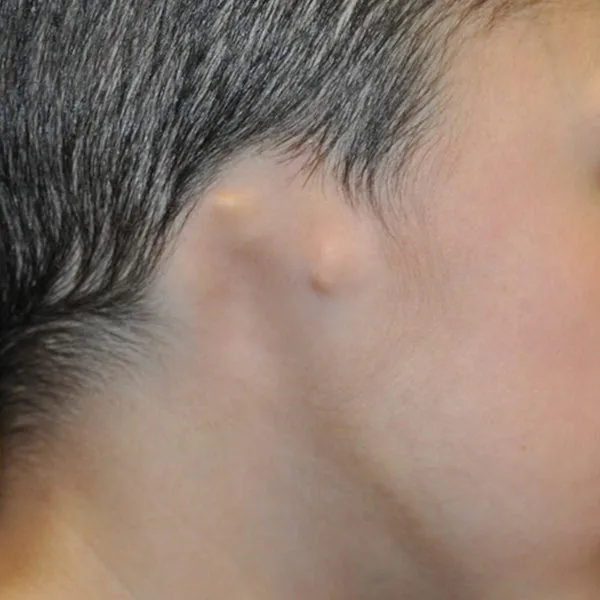
Microtia is a congenital condition in which the external ear is underdeveloped or absent at birth. The word comes from the Latin micro meaning small and otia meaning ear. Microtia occurs in approximately 1 in 6,000 to 12,000 births and ranges in severity from a slightly small but recognizable ear all the way to complete absence of the external ear. Microtia most commonly affects one ear — called unilateral microtia — though both ears can be affected in bilateral microtia. Despite the external appearance, the inner ear and hearing nerve are almost always completely normal.
What causes microtia?
In most children, no single cause can be identified. Genetic and other developmental factors can contribute. Vascular disruption is a proposed mechanism, not an established explanation for every child. Medical and family history can guide individualized discussion without assigning blame.
Can microtia be passed on genetically?
In most cases microtia is not genetically inherited and occurs without any family history. However, genetic causes of microtia are an active area of research. Certain syndromes associated with microtia — such as Treacher Collins syndrome — do have a hereditary component with a meaningful chance of passing to a child. For isolated microtia without an associated syndrome, the recurrence risk in future pregnancies is low — families who are concerned about recurrence are encouraged to consult with a genetics specialist. A consultation with a medical geneticist — part of Dr. Bonilla’s care team — can provide personalized guidance.
Is microtia associated with other conditions?
Microtia can occur as an isolated finding or it can be associated with syndromes affecting other structures of the face and head. The most common associated syndrome is hemifacial microsomia which involves underdevelopment of one side of the face. Treacher Collins syndrome, Goldenhar syndrome, and other craniofacial conditions can include microtia as one component. The overwhelming majority of children with isolated, unilateral microtia have no associated conditions. Dr. Bonilla can discuss referral for genetic evaluation when appropriate.
How common is microtia?
Microtia is uncommon, and reported rates vary by population and study. It affects boys slightly more often than girls and the right ear is affected more commonly than the left in unilateral cases. Bilateral microtia affects both ears and is less common than unilateral microtia. Dr. Bonilla has treated patients from more than 50 countries representing thousands of families across every continent.
The Four Grades of Microtia — Explained
Microtia is classified into four grades based on severity. Understanding your child’s grade is the foundation for understanding the reconstruction plan, surgical timing, and hearing strategy.
What are the four grades of microtia?
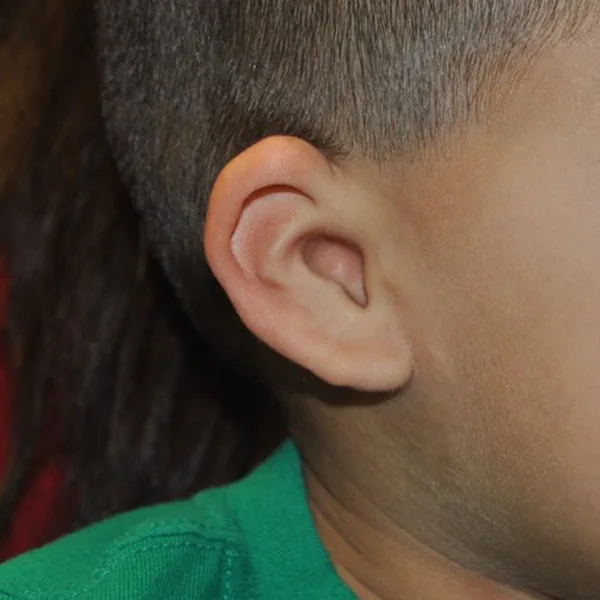
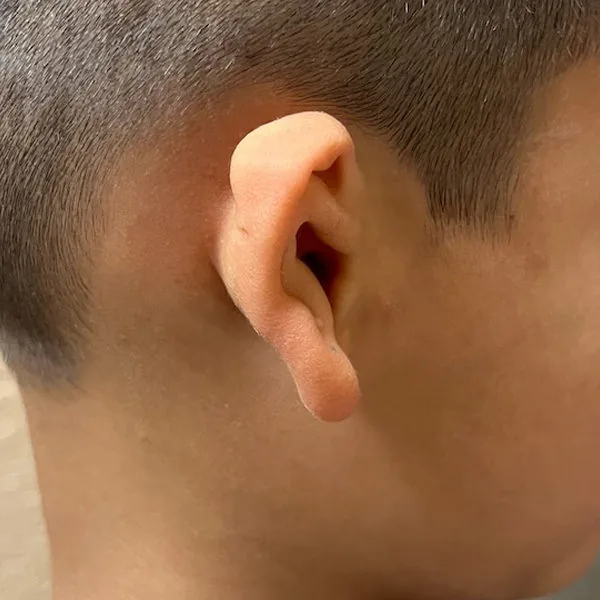
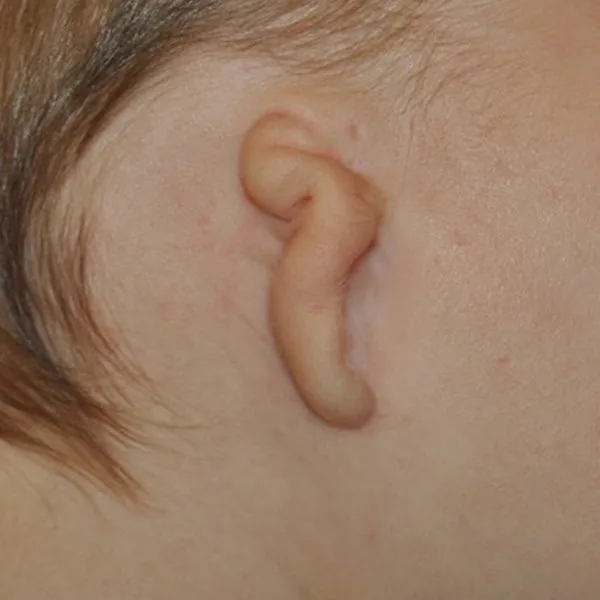
Microtia is classified into four grades based on severity. Grade I is the mildest form — the ear is smaller than normal but all major structures are recognizable and present. Grade II involves partial development — the lower half including the earlobe is typically present but the upper half is absent. Grade III is the most common type — the classic peanut-shaped cartilage remnant with no recognizable ear structures. Grade IV is the most severe — complete absence of the external ear, also called anotia.
Which grade is most common?
Grade III microtia is the most common type. This is why Dr. Bonilla’s reconstruction technique is built around Grade III anatomy, and why its outcomes are well documented.
Does the grade affect hearing?
Yes — grade affects the likelihood and severity of hearing loss. In Grade III and IV microtia the ear canal is almost always absent, causing moderate to severe conductive hearing loss. In Grade II the canal may be present but narrow. In Grade I a functional canal is often present. Crucially, the inner ear — the cochlea and hearing nerve — is almost always completely normal in all grades. The hearing organ works perfectly. It simply cannot receive sound through the absent ear canal.
The hearing organ is almost always completely normal
The cochlea — the inner ear hearing organ — develops from a completely separate embryological structure and is almost never affected by the same disruption that creates microtia. The hearing organ works perfectly. It simply cannot receive sound through the absent ear canal. This is why hearing intervention is so effective and why outcomes are so consistently excellent.
Understanding hearing in microtia patients
Can you still hear if you have microtia?
Yes — but hearing is affected in most cases. The vast majority of patients with microtia and aural atresia have moderate to severe conductive hearing loss. Because there is no ear canal, sound cannot travel through the outer and middle ear to reach the inner ear. The critical good news is that the inner ear and hearing nerve are almost always completely normal. The hearing organ works perfectly — it simply cannot receive sound through the absent ear canal.
What is aural atresia?
Aural atresia is the medical term for absence of the ear canal. It occurs in the majority of microtia cases — particularly Grade III and IV. In aural atresia the ear canal is replaced by a solid plate of bone. This is the primary cause of hearing loss in microtia patients. The inner ear develops from a completely separate embryonic structure and is therefore almost always unaffected.
How is hearing loss treated in microtia patients?
There are several effective options. Bone conduction hearing devices — including BAHA softbands for infants and surgically implanted devices for older children — bypass the absent ear canal and deliver sound directly to the normal cochlea through the skull. Atresiaplasty — ear canal surgery — is an option for carefully selected patients with favorable CT scan findings. Dr. Bonilla coordinates both outer ear reconstruction and hearing rehabilitation as part of a comprehensive treatment plan.
When should hearing intervention begin?
Arrange hearing assessment promptly. A softband bone-conduction device can be fitted in infancy without surgery when indicated. For infants with bilateral aural atresia, Dr. Bonilla recommends fitting within the first two months, coordinated with diagnostic testing. Do not wait for reconstruction to address hearing needs.
Surgery Timing & Candidacy
When is the right age for microtia ear reconstruction?
The optimal age is between 6 and 9 years old. By age 6 the rib cage has grown sufficiently to provide enough cartilage for a full-sized ear framework and the opposite ear has reached approximately 85 to 90% of its adult size — allowing Dr. Bonilla to create a closely matched result. Surgery before age 6 risks using cartilage that is too soft and insufficient in volume.
Can microtia reconstruction be done in adults?
Yes — reconstruction can be performed at any age. Adults who did not have reconstruction as children are excellent candidates. Dr. Bonilla has performed successful reconstructions in patients ranging from age 6 through adulthood with no upper age limit for candidacy. Adult rib cartilage is typically more firm which can actually produce excellent structural detail in the framework.
What determines candidacy for surgery?
The primary factors are age of at least 6 years, sufficient rib cartilage development, and overall health. For hearing surgery, a CT scan of the temporal bone evaluates middle ear structures and determines atresiaplasty candidacy. A consultation with Dr. Bonilla provides a personalized candidacy assessment for each child — including age, rib cartilage development, grade, and overall health.
Surgical Outcomes — Key Numbers
Dr. Bonilla has specialized exclusively in pediatric microtia since 1996, performing no other surgical procedure. This degree of exclusive focus is unusual in reconstructive surgery and is reflected in his case volume and published outcomes.
The Surgical Stages
What is distinctive about Dr. Bonilla’s approach to microtia reconstruction?
Dr. Bonilla has devoted his entire surgical career to pediatric microtia — no other procedures, no other patient population. That singular focus is reflected in the depth of his clinical experience.
How many surgeries will my child need?
Grade II microtia reconstruction is completed in one stage. Grades III, IV, and other grades requiring full reconstruction are completed in two stages spaced approximately two months apart.
What happens during each stage?
Stage 1 — Dr. Bonilla harvests rib cartilage, hand-carves and places the ear framework, rotates the earlobe into position, forms the tragus, and deepens the concha. This is the only stage requiring an overnight hospital stay and drains.
Stage 2 — The ear is elevated away from the head to create the sulcus and match the projection of the opposite ear. A hearing implant may be combined with Stage 2 when appropriate for the individual child. Stage 2 is outpatient with same-day discharge, and a sponge behind the ear is removed at a follow-up visit 5–7 days later.
Does microtia surgery hurt?
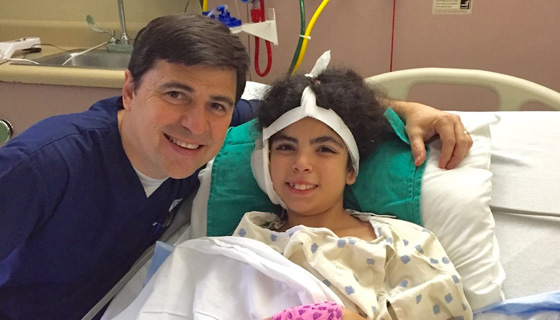
Microtia surgery is remarkably well tolerated. Average pain is 1 to 2 on a 10-point scale. An intraoperative epidural placed by the pediatric anesthesiologist provides excellent pain control through the first 24 hours. Most patients use children’s Tylenol or other oral pain medication as prescribed afterward. Parents are consistently surprised by how comfortable their child is.
Results & Longevity
How natural does the reconstructed ear look?
In experienced hands, natural rib cartilage reconstruction produces results remarkably close to a natural ear. Dr. Bonilla uses the mirror image of the normal opposite ear as his template — matching every contour, curve, and structural detail. Results continue to improve as swelling resolves and skin molds to the framework over the first year after each stage.
How long do results last?
Results are long-lasting. Natural cartilage is durable and grows with the child — with good post-operative care, results are expected to last a lifetime. Some loss of definition can occur over time without proper care. Patients reconstructed by Dr. Bonilla decades ago continue to have excellent results today. His earliest patients — children operated on in the late 1990s — are now adults in their thirties with intact, proportionate reconstructions.
National ASPS survey, as reported in a 2013 systematic review.1
Rib Cartilage — The Most Widely Used Reconstruction Technique
Why is rib cartilage the most recommended technique worldwide?
Over the past 50 years, natural rib cartilage has been and remains the gold standard for ear reconstruction worldwide. A 2013 systematic review, citing a national ASPS survey, reported that more than 90% of surveyed surgeons chose autologous cartilage reconstruction.1 Natural cartilage is the patient’s own tissue, sculpted into an individualized three-dimensional ear framework without a synthetic polyethylene implant. Reconstruction is intended to provide a lasting result, with follow-up to assess healing, appearance, and changes as the child grows.
Is rib cartilage microtia reconstruction a 3D ear reconstruction?
Yes. Every ear is three-dimensional — a flat ear would not exist. Dr. Bonilla’s technique creates a 3D ear framework hand-sculpted from the child’s own rib cartilage during surgery, shaped to match the child’s contralateral ear and specific anatomy. Medpor and Su-Por reconstruction also produces a 3D ear, but the framework is a pre-formed polyethylene implant manufactured in advance and selected by size. Both approaches result in a three-dimensional ear; they differ in whether the 3D shape is sculpted from the child’s own living tissue or built around a synthetic framework.
Is rib cartilage reconstruction more invasive than Medpor or SuPor?
This is one of the most common misconceptions in microtia care. Synthetic implant surgery typically takes 7 to 10 hours in a single session. Dr. Bonilla’s rib cartilage reconstruction for Grade II microtia averages approximately 3 hours. For Grade III, each individual stage is shorter than a single synthetic implant surgery. Recovery time is comparable. The critical difference is not invasiveness — it is the material and its lifelong implications.
Single-Stage Rib Cartilage vs. Synthetic Implant — The Facts
| Dr. Bonilla — Natural Rib Cartilage | Medpor / SuPor Synthetic | |
|---|---|---|
| Surgery Time | ~3 hours | 7–10 hours |
| Material | Patient’s own natural tissue | Synthetic implant (polyethylene) |
| Grows With Child | Yes — living tissue grows | No — plastic never grows |
| Natural Flexibility | Yes — flexes like a real ear | No — rigid for life |
| Lifetime Fracture Risk | None | Yes — permanent risk |
| Exposure Risk | None | Yes — permanent risk |
| Revision If Needed | Moderate difficulty | May need replacement with a slightly smaller implant |
| Sleeping Comfort | Normal | Firm implant material — discomfort when sleeping on the ear commonly reported |
| Permanent Result | Yes — with good post-operative care | Lifetime exposure and revision risk present |
What are the risks of synthetic implants?
Synthetic implants carry permanent lifelong risks. The most serious are implant fracture and exposure — where the rigid plastic pushes through the overlying skin. These complications can occur at any point in life and are extremely difficult to repair. The synthetic ear does not grow with the child and cannot flex naturally. Revision surgery on a failed synthetic implant is among the most technically challenging procedures in reconstructive surgery.
Will the reconstructed ear grow with my child?
Yes — when natural rib cartilage is used, the reconstructed ear grows with the child because it is living tissue. A synthetic implant does not grow — it remains fixed plastic while the child and the opposite ear continue to grow throughout childhood and adolescence, creating an increasingly visible asymmetry over time.
Bilateral Microtia
Bilateral microtia has unique implications for both reconstruction and hearing because both ears require surgery and hearing loss affects both sides simultaneously.
- More likely to have a genetic or syndromic cause — genetics evaluation is important
- Hearing intervention is urgent from birth — a bilateral BAHA softband within weeks
- Normal language development is achievable with prompt, bilateral hearing support
- Higher recurrence risk in families than unilateral cases
- Visit 1: Stage 1 on Ear 1
- Visit 2: Stage 2 on Ear 1 + Stage 1 on Ear 2
- Visit 3: Stage 2 on Ear 2 — approximately 4 months total
- Without a normal opposite ear as template, Dr. Bonilla uses standardized anatomical proportions
- Excellent symmetry achievable with experienced technique
What is bilateral microtia?
Bilateral microtia means both outer ears are affected. Hearing depends on each ear's anatomy and test results. Reconstruction and hearing care are planned individually. Associated findings or family history may prompt genetic evaluation.
How is bilateral reconstruction different?
Dr. Bonilla coordinates bilateral reconstruction in three surgical visits over approximately four months. Visit 1 is Stage 1 on Ear 1. Visit 2 combines Stage 2 on Ear 1 with Stage 1 on Ear 2 under the same anesthesia. Visit 3 is Stage 2 on Ear 2. Each ear has its own rib cartilage harvest, taken from the side of the chest opposite the ear being reconstructed, during that ear’s Stage 1.
How is hearing managed in bilateral microtia?
Prompt pediatric audiology assessment is essential. For infants with bilateral aural atresia, Dr. Bonilla recommends softband fitting within the first two months, coordinated with diagnostic testing. Early hearing care supports development, with follow-up to identify additional needs.
What families ask most in the first days after diagnosis
Related Resources
The most useful next resources depending on where you are in your journey.
Contact Dr. Bonilla’s Office
Dr. Bonilla and his team are available to answer questions specific to your child — by contact form or phone.