Questions to Ask Any Microtia Surgeon
Coming to a surgical consultation prepared with the right questions helps families make more informed decisions. Enter your child's grade and age to generate a personalized, printable question list for any consultation.
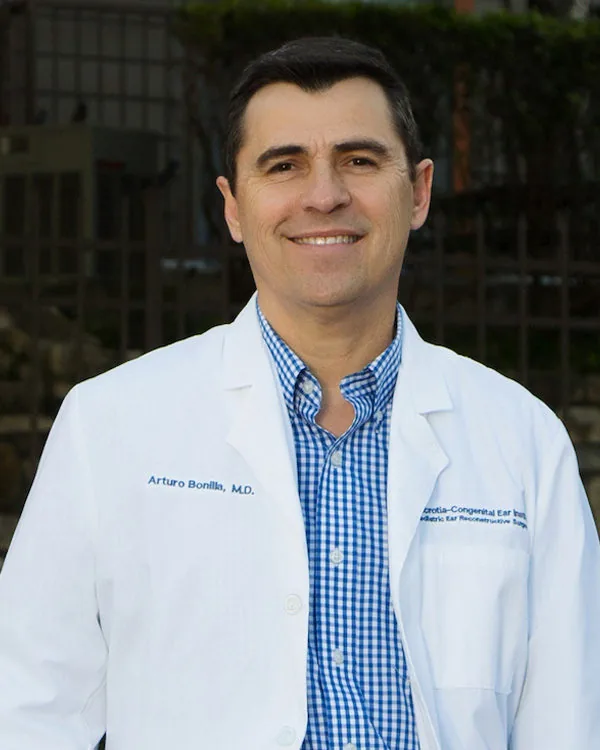
Medically reviewed by Arturo Bonilla, MD — August 2026
25 Questions Every Family Should Ask Any Microtia Surgeon
These questions apply regardless of which surgeon you are consulting. Under each question is a note on what a well-informed answer looks like — and what to watch for.
- How many microtia reconstructions have you performed in your career?
A surgeon with genuine expertise should give you a specific number. Fewer than 100 total career cases is a meaningful concern for a procedure this technically demanding. What defines the best microtia surgeon → - Is pediatric microtia reconstruction your primary or exclusive focus?
Most surgeons who perform microtia also perform many other procedures. Ask what percentage of their surgical volume is microtia specifically. Concentration of experience matters enormously in a rare condition. Why exclusive focus matters → - How many microtia cases do you perform each year currently?
Current volume matters as much as career total. A surgeon who performed many cases years ago but now does only a few per year has allowed active proficiency to decline. Evaluating surgical volume → - Have you published peer-reviewed research on microtia reconstruction?
Publication means the surgeon's work has been independently evaluated by other experts. It is not a requirement for technical excellence, but it is a strong signal of accountability to documented outcomes. Dr. Bonilla's peer-reviewed publications → - Can I see before and after photographs of your own patients across all grades?
Any experienced microtia surgeon should show you extensive documentation of their personal results — not stock images or colleagues' work. If a surgeon cannot produce a substantial gallery, that is a red flag. Before and after results gallery →
- Which technique do you use — natural rib cartilage, synthetic implant, prosthetic, or another approach?
Natural rib cartilage is used by the overwhelming majority of experienced microtia surgeons worldwide because it uses the child's own living tissue, grows with the child, and carries no lifetime implant risk. Rib cartilage vs. Medpor compared →Parents often ask“We were told a prosthetic ear is non-surgical and immediately reversible. Wouldn’t that be the safest first step?”
A prosthetic ear is an adhesive or implant-retained cosmetic covering — not reconstruction. It does not grow with the child, requires daily maintenance, is not waterproof, and can detach. Importantly, prosthetic fitting does not interfere with future surgical reconstruction. The question is not whether a prosthetic is reversible — it is whether it provides what the family actually wants for their child’s lifetime.
- Why do you recommend this technique for my child specifically?
The surgeon should explain the reasoning based on your child's grade, anatomy, and age — not simply because it is the only technique they offer. A thoughtful answer demonstrates individual evaluation rather than a one-size-fits-all approach. How technique is matched to each child → - How many surgical stages will my child need, and how far apart are they?
Dr. Bonilla plans one or two surgeries, depending on the grade of microtia and the patient’s anatomy. First surgery: Cartilage Ear Reconstruction. Second surgery, if needed: Ear Elevation. When two surgeries are needed, treatment is generally completed over approximately two months; the second surgery may include placement of a bone-conduction hearing implant when selected. Microtia surgery stages explained →Parents often ask“We’ve heard that synthetic implant surgery can be done in one stage. Doesn’t fewer surgeries mean less risk?”
Dr. Bonilla plans one or two surgeries, depending on the grade of microtia and the patient’s anatomy. First surgery: Cartilage Ear Reconstruction. Second surgery, if needed: Ear Elevation. When two surgeries are needed, treatment is generally completed over approximately two months; the second surgery may include placement of a bone-conduction hearing implant when selected. The number of visits is only one factor to discuss when comparing techniques.
- Will you personally perform every stage of the reconstruction?
In some practices, stages may be delegated to a fellow or associate. For a procedure this precise, you want the same surgeon performing every stage. Continuity directly affects outcomes. The surgical process stage by stage → - What does the rib cartilage harvest involve — incision size, healing, and long-term chest wall effects?
Ask the surgeon to explain the expected incision size, healing, and effects on the chest wall. In Dr. Bonilla’s practice, there have been no functional chest deformities. A surgeon experienced in this technique should explain it confidently and specifically. What the rib cartilage harvest involves →
- What are the most common complications with your technique?
Every technique has a complication profile. A trustworthy surgeon discusses this honestly — infection, skin irregularities, cartilage issues — and gives you realistic frequency data. Be cautious of a surgeon who describes their technique as complication-free. Complication rates compared by technique →Parents often ask“The surgeon we consulted said synthetic implant surgery has a lower complication rate. Is that accurate?”
Published data tells a different story. Synthetic implant reconstruction carries documented risks of implant exposure through the skin, fracture from trauma, and infection requiring implant removal — risks that persist for the child’s entire life. Natural rib cartilage carries none of these lifetime implant risks because there is no synthetic ear framework. The complication profiles of the two techniques are fundamentally different in both type and long-term trajectory.
- What is your revision rate — how often do patients require additional procedures after the defined stages?
High-volume surgeons with refined technique have lower revision rates. Ask for a specific number or percentage, not a general reassurance. Vagueness on this question is a signal. What the published clinical record shows → - If a revision is needed, can you perform it — and what does it involve?
The critical issue is sequence. If a cartilage reconstruction requires additional work, the surgeon is still operating in a preserved tissue environment — options remain open. If a synthetic implant is placed first and a complication arises, the scarring from the fascia flap destroys the skin elasticity natural reconstruction requires — potentially closing that path permanently. Why sequence matters — cartilage first →Parents often ask“If something goes wrong with cartilage surgery, isn’t a synthetic implant easier to remove than redoing cartilage?”
This question focuses on the wrong direction. Cartilage reconstruction should always be performed first — because if it requires further work, all future options remain available. The skin environment is preserved and uncompromised. If a synthetic implant is placed first and complications arise, the temporoparietal fascia flap has permanently consumed tissue and created scarring that destroys the skin elasticity natural reconstruction requires. That sequence cannot be reversed. Cartilage first is not just a preference — it is the only sequence that keeps all doors open.
- What happens to the reconstruction as my child grows through adolescence and into adulthood?
This is one of the most important long-term questions a parent can ask. Living rib cartilage grows with the child and ages naturally. Synthetic implants do not grow and carry lifetime fracture and exposure risks. Ask to see documented long-term outcomes — not just early results. Long-term outcomes with rib cartilage →Parents often ask“The before and after photos of synthetic implant surgery looked incredible. Why would we choose multiple stages when the result looks that good immediately?”
Early results can look similar between techniques. The difference emerges over time. A synthetic implant is a fixed size placed at a specific moment in the child’s development — it does not grow. As the child’s face grows through adolescence, the relationship between the implant size and facial proportions may shift. Natural rib cartilage is living tissue that grows in proportion with the child’s face. When evaluating any surgeon’s results, ask to see long-term outcomes in adult patients — not just immediate post-operative photographs.
- Does your practice address hearing, or do you refer to another specialist?
Microtia and aural atresia require coordinated care between the reconstructive surgeon and an audiologist or neurotologist. Understand clearly whether the surgeon manages hearing coordination or leaves that navigation entirely to you. Your child's microtia care team → - At what point in the reconstruction process should we pursue atresiaplasty evaluation?
Atresiaplasty — ear canal surgery — must be carefully sequenced relative to outer ear reconstruction. If it is performed first, it can compromise the skin and blood supply needed for reconstruction. The sequencing decision requires active coordination between specialists. Atresiaplasty sequencing explained → - Can a bone-anchored hearing implant be placed concurrently with ear reconstruction?
A BAHA implant can be placed during Stage 2 when chosen, reducing total surgical events for the child. Ask specifically whether it is an option. Bone-anchored hearing devices and timing → - Who manages the coordination between the ear reconstruction and any hearing surgery?
This reveals whether the practice has an established referral network or whether you will navigate coordination independently. For bilateral microtia families especially, clear specialist coordination is essential to safe outcomes. How the microtia care team coordinates →
- What is the earliest age at which you will consider reconstruction?
Most experienced surgeons recommend waiting until age six to nine, when rib cartilage is sufficiently developed for a well-proportioned framework. A surgeon offering surgery at age four or five may be responding to parental pressure rather than clinical best practice. Surgery candidacy and timing →Parents often ask“Another surgeon offered to operate when our child is 4 years old. If we can do it sooner, why would we wait?”
Early surgery offers at age 4 or 5 come almost exclusively from surgeons using synthetic implants, because synthetic reconstruction does not require rib cartilage and can technically be placed before the child’s cartilage is sufficiently developed. Rib cartilage reconstruction requires waiting until adequate cartilage volume is available — typically age 6 to 9 — because a framework carved from insufficient cartilage produces an undersized, disproportionate result that is very difficult to correct. The result your child will live with for the rest of their life should not be rushed. If a surgeon is willing to operate at age 4, ask them specifically what technique they use and why they recommend it at that age.
- What physical criteria determine whether my child is ready — age, size, or rib cartilage development?
The definitive answer should involve direct assessment of rib cartilage volume and quality — not simply age or weight alone. A surgeon who assesses candidacy without examining the cartilage is not applying the standard of care. How candidacy is assessed → - Is my child's grade of microtia a factor in timing or technique?
Grade matters for both surgical planning and timing. Grade II cases are structurally simpler and may be completable in a single stage. Grade IV cases require more cartilage and more precise staging. The answer should be grade-specific, not generic. The four grades of microtia explained → - What happens if we choose not to pursue surgery now — can we revisit the decision later?
Surgery should always be a choice, never an obligation. A trustworthy surgeon will tell you that reconstruction can be pursued at any point during childhood — and that the decision belongs to the family, not the surgeon. Surgery is always a choice →
- How long will my child need to be away from school after each stage?
Most children return to normal activity within one to two weeks. Ask for stage-specific guidance because Stage 1 recovery differs from Stage 2. Many families schedule around school breaks, but surgery can be scheduled at any time of year. Recovery after each surgical stage → - What activity restrictions apply after each surgical stage?
Contact sports and swimming are typically restricted for four to six weeks after each stage. Once the recovery period ends, all activities resume normally. The rib cartilage framework is durable once fully healed. Activity guidelines after reconstruction → - What follow-up care is required, and do you manage it remotely for traveling families?
Many families travel significant distances for microtia surgery. An experienced practice should have a clear protocol for remote follow-up — including photo review, telehealth check-ins, and coordination with local physicians for routine post-operative care. Traveling families — coordination and follow-up →
Questions for My Child's Microtia Consultation
Generated at microtia.net — Questions for Your Microtia Surgical Consultation
Your Question List
Contact Dr. Bonilla
If you'd like to bring these questions to Dr. Bonilla, his team is available to schedule a consultation by contact form or phone.
To request a consultation with Dr. Bonilla, submit your information through our contact form and his team will be in touch to schedule a virtual appointment.