Treatment Options

Microtia Treatment — All Four Options Explained

Microtia reconstruction is one of the most technically demanding procedures in plastic surgery. There are four approaches available today. This page explains all four honestly — what each involves, what the trade-offs are, and why Dr. Bonilla exclusively performs rib cartilage reconstruction. For families still learning about the microtia treatment and overall condition, the main microtia overview page is a helpful starting point.

All four approaches produce a three-dimensional ear — the meaningful difference is whether that 3D shape is sculpted from the child’s own cartilage, built around a pre-formed polyethylene implant, fitted as a prosthetic, or simply not pursued.
Four treatment paths clearly explained Honest pros & cons for each option Dr. Bonilla performs only rib cartilage reconstruction Surgery typically begins age 6–9
Request a Consultation How the Surgery Works
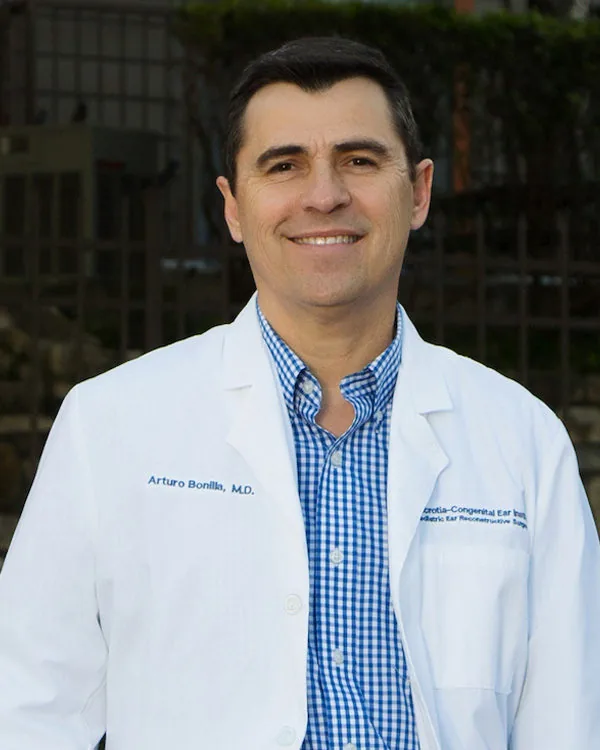
Dr. Arturo Bonilla MD
Dr. Arturo Bonilla, MD — Written & Medically Reviewed
Fellowship-Trained · Pediatric Microtia Surgeon · Pediatric Otolaryngologist · Exclusively microtia since 1996 · Last reviewed 2026 · Updated regularly
✓ Medically Reviewed
Dr. Bonilla’s Approach

Why rib cartilage — and why it’s the only technique Dr. Bonilla performs

In thirty years of microtia surgery, Dr. Bonilla has reached a clear and unwavering conclusion: there is nothing that can replace the body’s own living cartilage. The rib cartilage technique is not merely the most widely used approach in the world — it is the only approach using the patient’s own living tissue, which grows with the child and carries no rejection risk without requiring replacement or management of implant complications.

Dr. Bonilla does not use Medpor/Su-Por as the outer ear reconstruction framework. Families sometimes arrive having been told that rib cartilage reconstruction is more painful, more invasive, or more risky than synthetic implant surgery. Synthetic implant surgery such as Medpor or Su-Por typically requires between 7 and 10 hours under general anesthesia in a single session. By comparison Dr. Bonilla’s rib cartilage reconstruction — even when staged across multiple procedures — involves significantly shorter individual surgeries with well-tolerated recoveries. Synthetic implants also carry a permanent lifetime risk of exposure, fracture from trauma, and loss of sensation. When these complications occur revision surgery is often required — and in some cases the entire implant must be removed and replaced, potentially requiring multiple additional surgeries over the course of the patient’s lifetime. The temporal parietal fascia flap required to cover synthetic implants is itself a significant additional procedure. These are clinical realities that Dr. Bonilla considers it his responsibility to share honestly with every family he sees.

30+
Years performing exclusively rib cartilage reconstruction
#1
Most widely used technique worldwide for microtia reconstruction
1–3
Surgical stages to complete natural ear reconstruction
Lifetime of the result — cartilage grows with the child, permanently
Option 1 of 4

Rib Cartilage Reconstruction — The Most Widely Used Technique Worldwide

The rib cartilage technique is the most widely performed microtia reconstruction approach in the world and the standard of care at all leading academic centers. It is the only technique Dr. Bonilla performs.

How many surgeries will my child need?
Grade I
Surgery Rarely Recommended
A naturally formed ear is almost always preferable to reconstruction. Dr. Bonilla monitors Grade I patients carefully over time, with a focus on hearing assessment.
Grade II
1 Surgery
Full reconstruction complete in a single stage, averaging approximately 3 hours. Overnight stay, then home after drain removal at one week.
Grade III
2–3 Surgeries
Skin elasticity determines whether 2 or 3 stages are needed. Dr. Bonilla evaluates this at consultation and may confirm during the first surgery. Total reconstruction typically complete within 2–4 months.
Grade IV
2 Surgeries
No earlobe transposition required. Streamlined two-stage approach. Full result typically achieved within 2–3 months.
All stages spaced approximately 2 months apart. Full reconstruction is complete well within a single year for all grades. For bilateral microtia, Dr. Bonilla’s coordinated staging approach completes both ears in approximately 2–6 months.
Global surgical consensus

Why do 9 in 10 microtia surgeons worldwide choose rib cartilage?

91.3%
of microtia surgeons worldwide prefer natural rib cartilage over synthetic implants — published in the Facial Plastic Surgery Clinics of North America. Dr. Bonilla is principal author of the 1,000-patient series underlying this data. View full research summary →
Rib Cartilage
Most accepted worldwide
91.3%
Medpor / Su-Por
~6%
No surgery
~2%
Prosthetic
~1%
Why cartilage wins globally

It is the patient’s own living tissue. It grows with the child, cannot be rejected, flexes under impact, and requires no replacement — ever.

The one-surgery talking point

Medpor/Su-Por is done in one session — but that session typically requires 7–10+ hours of anesthesia (longer than Dr. Bonilla’s entire surgeries combined) and can often require another visit for revision or repair of fracture or exposure.

Source: Facial Plastic Surgery Clinics of North America — global survey of microtia surgical technique preference. Dr. Bonilla is principal author. PMID: 29153189

Option 1
Natural Rib Cartilage Reconstruction
Using the child’s own living tissue to build a permanent, growing ear
★ Gold Standard

Rib cartilage reconstruction involves harvesting cartilage from the child’s own rib cage (ribs 6, 7, and 8) and hand-carving it into a detailed, anatomically precise ear framework. This framework is placed beneath the skin near the ear site, where it integrates permanently with the surrounding tissue. Over the following stages, the earlobe is rotated, the tragus is created, and the ear is elevated from the skull to achieve natural projection. The result is a living ear — built from the child’s own body — that grows with them, feels like natural tissue, and never needs to be replaced.

Advantages

Uses the body’s own living tissue — no foreign material implanted
Grows with the child — no replacement or revision needed as they age
Lasts a lifetime — the cartilage is as permanent as any other part of the body
No risk of rejection — it is the patient’s own tissue
Sports, swimming, and physical activity carry no long-term risk to the reconstruction
No temporoparietal fascia flap required — less invasive than implant technique
Native skin covers all visible surfaces — no skin graft on the front of the ear
Gold standard for decades across all major academic medical centers worldwide
Small chest incision (~1.25 inches) — typically heals to a fine, nearly invisible line

Considerations

Technically demanding — results are highly surgeon-dependent; experience matters enormously
Requires one to three staged procedures over 1–4 months depending on grade
Small chest incision required for cartilage harvest
Must wait for adequate rib growth — typically age 6 or older
Brief activity restrictions after each surgical stage (4–6 weeks)
Dr. Bonilla exclusively performs this technique. It is the only approach that produces a living, growing, permanent result from the child’s own body. “In experienced hands, rib cartilage reconstruction consistently delivers results that last a lifetime. Nothing else does.”
Option 2 of 4

Porous Polyethylene Implant (Medpor/Su-Por)

A synthetic implant approach using a porous polyethylene framework covered by a fascia flap and skin graft. Used by some surgeons as an alternative to rib cartilage. Dr. Bonilla does not use this technique for outer ear reconstruction.

Option 2
Porous Polyethylene Implant (Medpor/Su-Por)
Synthetic framework covered by a temporoparietal fascia flap and skin graft
Alternative technique

The Medpor/Su-Por technique uses a pre-fabricated porous polyethylene framework rather than carved cartilage. Because synthetic material cannot simply be placed under the skin, this technique requires harvesting a temporoparietal fascia flap — a sheet of living tissue taken from the scalp above the ear — to cover and vascularize the implant. A skin graft is then placed over the fascia. The technique can be performed at a younger age and in fewer stages than cartilage reconstruction, but the trade-offs are significant and long-term.

Advantages

No chest incision required — avoids rib harvest
Can be performed at a younger age (some protocols begin at age 3)
Fewer surgical stages in some protocols
Can achieve good projection and structural definition

Significant disadvantages

Significant time under anesthesia — 7 to 10+ hours in surgery under general anesthesia
Temporoparietal fascia flap is invasive — requires elevation of scalp tissue above the ear
Scalp incisions may result in visible scarring, particularly in children with shorter hair
Hair loss at the harvest site is possible and may persist
Skin graft on the most visible, outside part of the ear differs from native skin — color mismatch is common
The implant does not grow with the child — may require revision as the face develops
Lifelong risk of implant exposure — porous polyethylene can erode through overlying tissue
Trauma carries lifelong risk of implant fracture requiring surgical intervention
Skin graft lacks the normal protective sensation of native skin
📋
Dr. Bonilla’s position: The temporoparietal fascia flap required for Medpor/Su-Por carries risks — particularly scalp scarring, hair loss, and the lifelong vulnerability of the implant from trauma. Because of the lifelong risk of fracture or exposure, he does not offer this technique for the outer ear.
Option 3 of 4

Auricular Prosthesis — A Prosthetic Ear

A medical-grade silicone prosthetic ear, custom-made and colored to match the patient’s skin tone, attached with adhesive or implanted anchors. A legitimate option in specific circumstances.

Option 3
Auricular Prosthesis
A custom silicone prosthetic ear — for specific patients and situations
For select patients

An auricular prosthesis is a custom-made silicone replica of the ear, individually tinted to match the patient’s skin. It is affixed daily with medical adhesive or anchored to small titanium implants in the skull via magnets or a bar. In trained hands, prosthetics can appear remarkably realistic. They are most appropriate when surgical reconstruction is not possible, when prior surgery has left tissue inadequate for further reconstruction, or when a patient is medically unsuitable for surgery.

Advantages

Avoids chest incision and fascia flap surgery
Can appear highly realistic when well-made and skin-matched
Viable option after failed cartilage or Medpor/Su-Por reconstruction
Appropriate for older patients who decline surgery or are medically unfit

Limitations

If implant-anchored: requires titanium implant placement in the skull
Must be removed every night — the child never fully “owns” it
Does not sweat or tan with surrounding skin — color mismatch over time
Requires ongoing maintenance and eventual replacement
Adhesive type may detach during activity or in humid conditions
Most patients report the prosthetic never feels psychologically integrated
📋
When Dr. Bonilla recommends a prosthetic: When prior reconstruction has consumed or compromised available tissue such that further surgery cannot achieve a good outcome, Dr. Bonilla will recommend a prosthetic rather than proceed. He will never recommend surgery he cannot perform with confidence. For these patients, a high-quality prosthetic is genuinely the best available option.
Option 4 of 4

No Surgery — A Legitimate Option

Choosing not to reconstruct is a legitimate decision. Many people with microtia live full, complete lives without ever having surgery. Dr. Bonilla counsels every family on this option honestly and without pressure.

Option 4
No Surgery — Watchful Waiting
A legitimate choice at any stage of childhood
Always valid

Many children and young people with microtia reach a point where the condition does not significantly affect their sense of self and they choose not to pursue surgery. This is a completely valid outcome. Dr. Bonilla will never pressure a family toward surgery.

The consideration that matters most: in children, reconstruction is most beneficial before the early school years, when peers are most likely to notice and comment on differences in appearance. Children who have reconstruction before starting first grade navigate those years with a reconstructed ear. This is the primary argument for pursuing reconstruction in childhood rather than deferring to adulthood — but it is not a mandate.

Advantages

Avoids all surgical risk and recovery periods
Many people with microtia live without any awareness that it limits them
The decision can always be revisited — reconstruction can be done at any point in childhood or adolescence

Considerations

Early school years are typically when peers are most likely to comment
Teenage years can amplify emotional impact for some individuals
Rib cartilage becomes progressively less pliable with age, making later surgery more complex
💬
All patients are counseled that it is perfectly reasonable to wait if they are not yet ready. Dr. Bonilla does not schedule a child for surgery when the parents or child have reservations. Readiness matters as much as timing.
🕐
Waiting is not permanent. Families who choose to defer surgery can revisit the decision at any point during childhood and adolescence. Dr. Bonilla will honestly reassess candidacy and timing whenever a family is ready to discuss it.
👂
For bilateral microtia: Children who choose not to reconstruct should still receive bone conduction hearing support from birth. The hearing decision and reconstruction decision are completely independent. Adequate hearing support is not optional for language development.
Comparing All Four Options

Side-by-side: how the four treatment options stack up

Factor ★ Rib Cartilage Medpor/Su-Por Prosthetic No Surgery
Tissue usedPatient’s own cartilageSynthetic + fascia flapSilicone deviceN/A
Anesthesia time1–3 hours (depending on stage)7–10+ hoursNoneN/A
Grows with childYes — permanentlyNoNoN/A
Rejection riskNoneLow but presentNoneN/A
Implant exposure riskNoneLifelong riskMinimalN/A
Sports / trauma riskMinimal after recoveryLifelong fracture riskProsthetic may detachN/A
Native skin on earYes — all visible surfaces (front & sides)No — skin graft on the most visible part of the earNoN/A
Hair loss riskNonePossible — scalp incisionNoneN/A
Chest incisionYes — small (~1.25 in)NoNoNo
Minimum age~6 years (size-dependent)~3 years in some protocolsAny ageN/A
Number of stages1–3 stages1–2 (depending if revision is needed for fracture or unhealed exposure)1 (implant) or 0 (adhesive)None
Daily maintenanceNone after completionMinimalDaily — on/off + adhesiveNone
Lifetime of resultPermanent — no replacementPossible revision over timeRequires replacementN/A
Dr. Bonilla performsYes — exclusivelyNoWhen indicatedAlways an option
When Does Surgery Begin?

Why age and size — not a calendar date — determine when reconstruction starts

The determining factor for when rib cartilage reconstruction begins is whether the child’s rib cage has grown enough to provide sufficient cartilage for a full, detailed ear framework.

The relationship between size and timing

Rib cartilage reconstruction requires a rib cage with adequate cartilage volume to carve a detailed ear framework. Dr. Bonilla assesses readiness by physical examination — feeling the ribs and gauging cartilage availability. The general guideline is age six or older, but this is not a strict rule.

A very small six-year-old may not yet have sufficient rib growth and will be asked to return in a year. A large five-year-old with generous rib development may be ready earlier. The child’s chest measurement, not their birthday, determines readiness.

The first-grade window

Where possible, Dr. Bonilla aims to begin reconstruction in the summer before the child starts first grade. By the time school begins, at least one or two surgical stages will have been completed and the ear is taking recognizable shape. Children tend to attract the most peer attention during the early school years. Beginning before first grade provides a meaningful social and emotional advantage.

This is not a rigid deadline — families who are not ready, or whose child is not yet large enough, should not feel rushed. But when readiness aligns, the timing is meaningful.

📋
For bilateral microtia: The same size-based timing applies. The first cartilage stage on the first ear typically begins at age 6–7, with the second ear following within weeks. Combination staging minimizes total anesthetic events. It is very important to complete external ear reconstruction before any middle ear canal surgery — operating on the canal first permanently compromises the skin available for reconstruction.
🤔
Large child for age
May start earlier
A large five-year-old with adequate rib development may be assessed as ready before the typical age-6 guideline. Evaluated by physical exam, not calendar alone.
Typical timing
Age 6–7
Most children have sufficient rib growth by age 6–7. The ideal window is the summer before first grade so the ear is taking shape when school begins.
🕐
Small child for age
Wait for growth
A small six-year-old may not yet have enough rib cartilage. Dr. Bonilla will recommend waiting until age 7–8 when sufficient cartilage is available.
🕐 Timing Summary
Earliest possible~5 years if very large for age
Typical windowAge 6–7 (size-dependent)
Ideal social timingSummer before first grade
If small at 6Wait until 7–8 for rib growth
Bilateral startAge 6–7, first ear first
Deciding factorRib size — physical exam
The Surgical Process

How the three-stage rib cartilage reconstruction works

Each stage of reconstruction has a specific purpose, builds on the stage before it, and results in visible progress the family can see. Stages are spaced approximately 2 months apart to allow complete healing. Total time from Stage 1 to completion is approximately 2 months for a two-stage reconstruction and approximately 4 months for a three-stage reconstruction.

Dr. Bonilla performs all three stages personally. The detail and artistry of the ear framework — the curvature of the helix, the depth of the concha, the definition of the antihelix — are the result of the surgeon’s hands. Experience cannot be substituted for in this technique.

🖥
Important for families considering middle ear surgery (atresiaplasty): External ear reconstruction must always be completed before any attempt to open the ear canal. Once the canal is operated on, the skin elasticity and circulation are permanently altered, compromising subsequent reconstruction. Reconstruction first — always.
Full surgical technique guide →
1
Stage 1 — The Foundation
Cartilage harvest & framework placement
Rib cartilage harvested from ribs 6, 7, and 8 through a small ~1.25-inch incision. Dr. Bonilla hand-carves it into a detailed anatomically precise ear framework. The framework is placed in a skin pocket near the ear site; a small drain maintains contact so skin conforms precisely to every carved detail. The ear structure is immediately visible through the skin after this stage.
~2.5–3 hrsOvernight hospital stay4–6 wks activity restriction
Dr. Bonilla uses a gold-contact laser during rib cartilage harvest — a technique that produces minimal thermal energy, precise tissue excision, and typically very low blood loss during the procedure.
2
Stage 2 — The Details
Earlobe rotation, tragus creation & conchal deepening
The preserved earlobe remnant is rotated to its correct anatomical position. The tragus is created. The conchal bowl is deepened and refined. All native skin — no skin graft on the visible surface. After Stage 2 the ear has complete anatomical shape, lying flat against the skull awaiting elevation.
~2 months after Stage 1Outpatient
3
Stage 3 — The Final Result
Ear elevation — permanent projection achieved
The ear is elevated from the skull to its natural projection angle. A small cartilage support and skin graft behind the ear (not on the visible front surface) maintains projection permanently. This produces the final, complete result. After healing, the ear sits naturally, projects correctly, and requires no further surgery or maintenance.
~2 months after Stage 2Final resultNo further surgery needed

Dr. Bonilla has performed rib cartilage reconstruction exclusively since 1996. A consultation will give your family a clear, specific, honest plan.